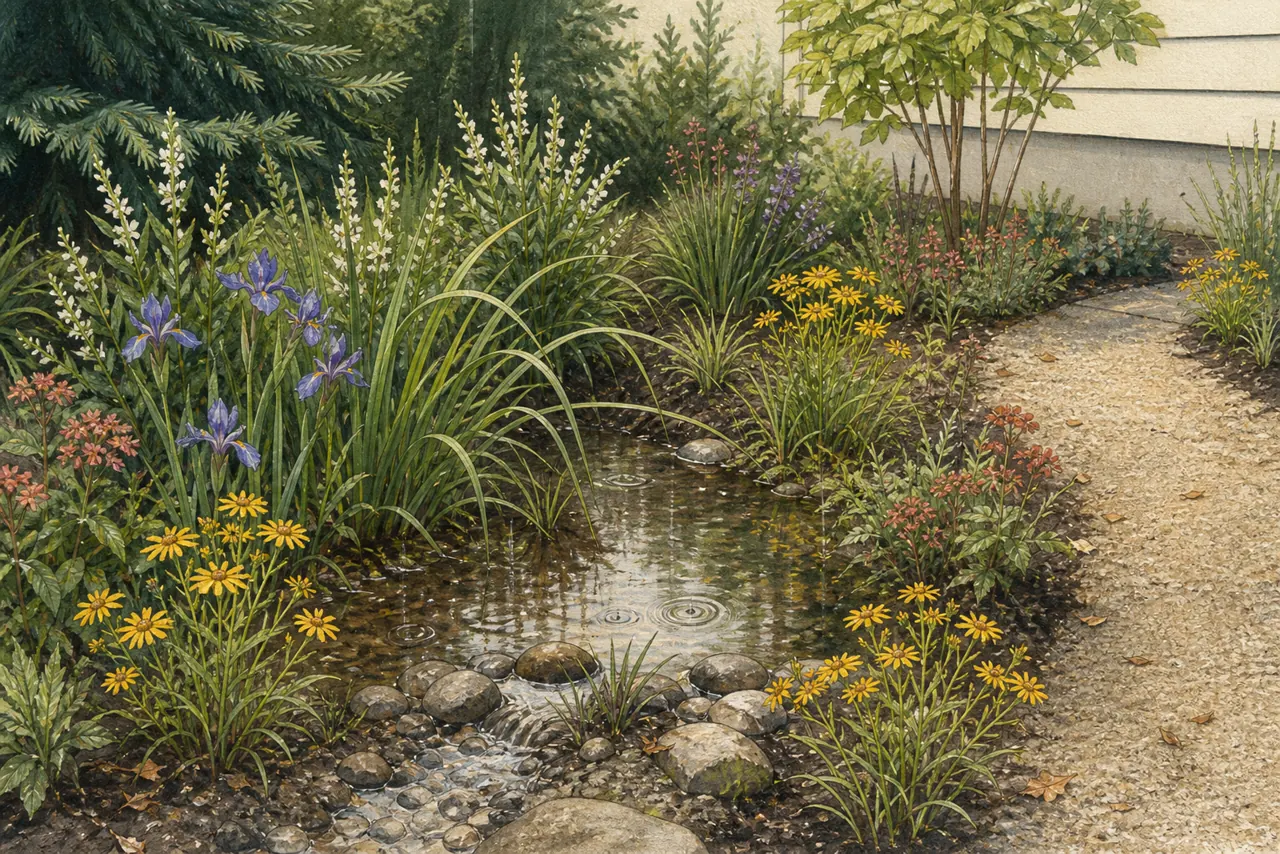
Design three moisture bands
The lowest basin receives the longest saturation, the sloped edge moves between wet and dry, and the upper rim behaves more like an ordinary bed. Planting all three with the same palette guarantees that part of the group will be mismatched.
Use swamp milkweed, cardinal flower, and tussock sedge in the reliably moist band. Put adaptable foxglove beardtongue or Virginia sweetspire on the slope. Reserve blue wild indigo and other dry-to-medium plants for the rim.
Keep water movement visible
Dense roots slow water and protect soil, but stems should not hide an eroding inlet or blocked overflow. Use a small stone splash pad where a downspout enters, leave a narrow inspection route, and check the feature during a storm.
If runoff cuts a channel, stands for extended periods, or threatens a building, stop adding plants and correct the hydrology with qualified local guidance. A rain garden is not the right answer for every drainage problem.
- Inlet: protect exposed soil and keep the flow path inspectable.
- Basin: repeat sedges and moisture-loving flowers in broad groups.
- Rim: use lower, neater plants where the feature meets lawn or a path.
Maintain the first two years
New rain gardens collect both water and weed seed. Weed monthly during the first growing season, replace plants that reveal a moisture mismatch, and keep sediment from burying crowns. Water during dry establishment periods even though the feature is designed for stormwater.
Once roots knit together, leave healthy stems through winter when access permits. Cut them back before spring growth and remove accumulated litter only where it blocks the inlet or overflow.
The working plant palette
These roles are a starting framework. Confirm county-level nativity, provenance, mature width, and nursery availability before purchase.
Swamp milkweed
Asclepias incarnata
A moisture-loving milkweed listed by Delaware Extension for rain gardens.
Cardinal flower
Lobelia cardinalis
Adds a strong late-summer red vertical in a reliably moist part of the feature.
Handles medium-to-moist soil and brings white late-spring flowers.
A medium-to-moist shrub for a larger feature where its mature width will not block flow.
Tussock sedge
Carex stricta
A sedge for wet ground that creates dense cover and persistent texture.
Place on the upper rim where water does not stand and a broad mature mound can fit.
A practical sequence
Trace inflow and safe overflow; contact utility marking before digging.
Measure infiltration and separate basin, slope, and rim moisture zones.
Install sedge matrix first, then flowering groups and any shrub anchor.
Watch several storms, remove sediment, and correct bare or eroding areas promptly.
- Do not locate a rain garden where infiltration could affect a foundation, septic system, steep slope, contaminated soil, or buried infrastructure.
- University plant lists can include species beyond Delaware’s local native flora; verify provenance and local status at purchase.
- University of Delaware Cooperative Extension — Rain Garden ↗
- University of Delaware — Educational Pollinator Garden ↗
- Delaware Department of Natural Resources — Livable Lawns / Native Plants ↗
Plant ranges and recommendations change as records improve. Read how we separate range, site fit, and design judgment in our sources and methodology.