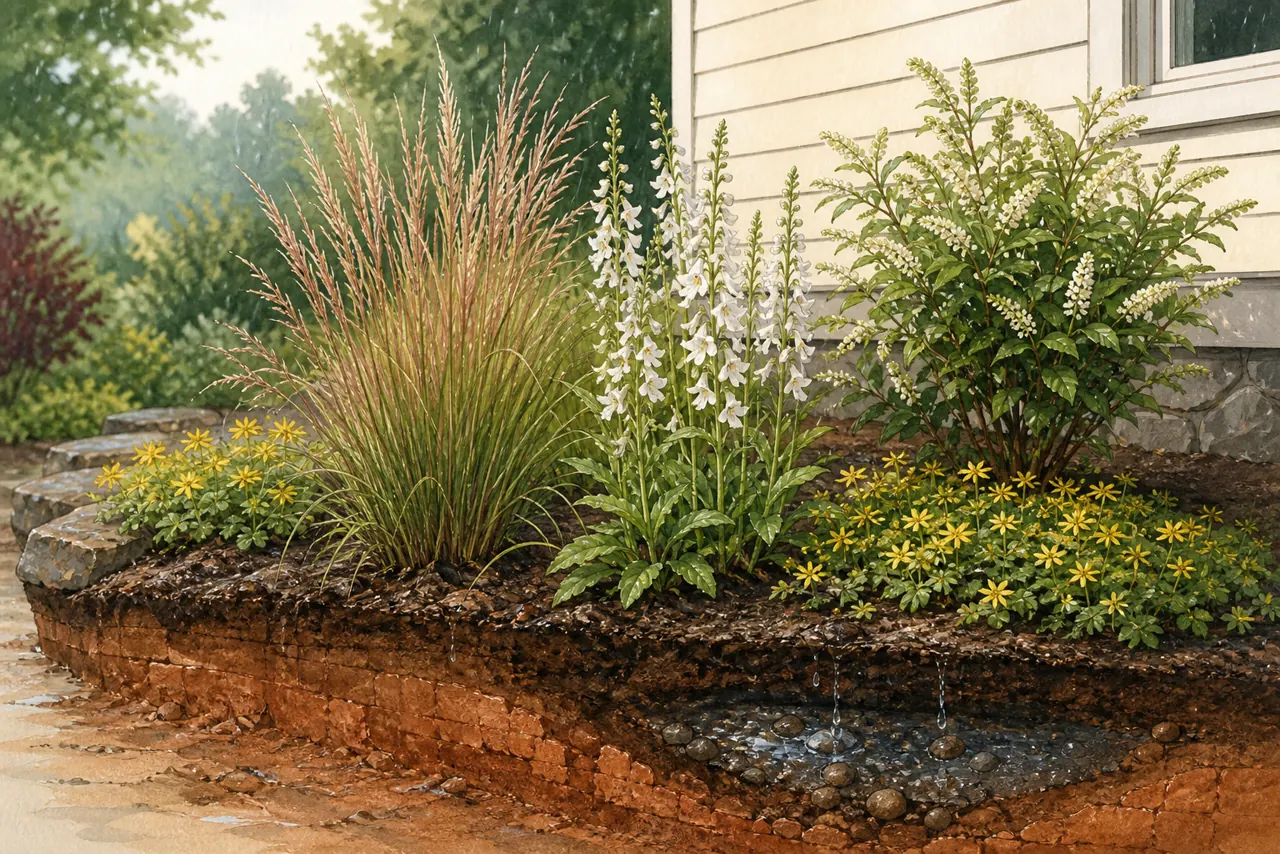
Treat drainage as a map, not a label
Maryland home sites often contain disturbed subsoil rather than an intact woodland profile. A flat bed beside a driveway may stay wet after storms while the exposed shoulder of the same bed bakes hard in July. Calling both areas ‘clay’ hides the decision that matters: how long roots remain saturated and how quickly the surface dries.
Dig a small observation hole away from utilities, fill it, let it drain, then fill it again. Pair that result with a rain-day walk. Do not route extra water toward a foundation, and do not treat a plant list as a repair for a failed drain or active erosion.
- Upper or sloped zone: prioritize clumping plants that tolerate dry-to-medium conditions.
- Level middle zone: use medium-moisture perennials and a dense ground layer.
- Lower zone: use wet-tolerant choices only if water leaves between storms; persistent standing water needs a different assessment.
Build two small palettes, not one long list
For a sunny upper bed, repeat little bluestem with foxglove beardtongue and a compact late bloomer such as aromatic aster. In a part-shade lower bed, use golden ragwort beneath Virginia sweetspire, with moisture-compatible accents. Repetition creates visual order and makes it obvious which plant is spreading outside its intended zone.
Avoid digging isolated holes full of imported loose soil inside dense clay. A sharply different pocket can hold water and keep roots circling inside the planting hole. Break glazed sides, set the crown at the correct level, and improve an entire bed only when a soil test and site goal justify it.
Plan for establishment, then reduce intervention
Water deeply during the first growing season, especially when a summer storm misses your neighborhood. Keep mulch thin and away from crowns. As plants knit together, allow living foliage and fallen leaves to replace part of the mulch layer.
Edit spreading species at a visible edge once or twice a year. That small amount of management is usually more effective than placing one of every species and fighting weeds between isolated plants.
The working plant palette
These roles are a starting framework. Confirm county-level nativity, provenance, mature width, and nursery availability before purchase.
Handles sun to partial sun and medium soil; its white spires make a repeated planting easy to read.
A clumping grass for sunny clay that drains between storms; keeps copper stems into winter.
Useful in a medium-moisture zone where a spreading colony can be bounded by a path.
Builds a low, semi-evergreen colony in a cooler, moisture-retentive part of the bed.
Fits a larger medium-to-moist pocket and provides flowers, fall color, and woody winter structure.
A practical sequence
Map sun, slope, compacted routes, and where water enters and exits.
Confirm ecoregion and choose one palette for each moisture zone.
Install the structural grass or shrub first, then repeat perennials and ground layer.
Water for root establishment; photograph the bed after major storms and summer dry spells.
- Persistent water near a basement, retaining wall, septic area, or electrical equipment needs qualified assessment.
- Maryland spans mountain, Piedmont, and Coastal Plain ecoregions; confirm local nativity rather than relying on a statewide label alone.
- University of Maryland Extension — Recommended Native Plants for Maryland ↗
- University of Maryland Extension — Removing Invasive Plants and Planting Natives ↗
- University of Maryland Extension — Maryland Native Plant Search Tool & Guides ↗
Plant ranges and recommendations change as records improve. Read how we separate range, site fit, and design judgment in our sources and methodology.