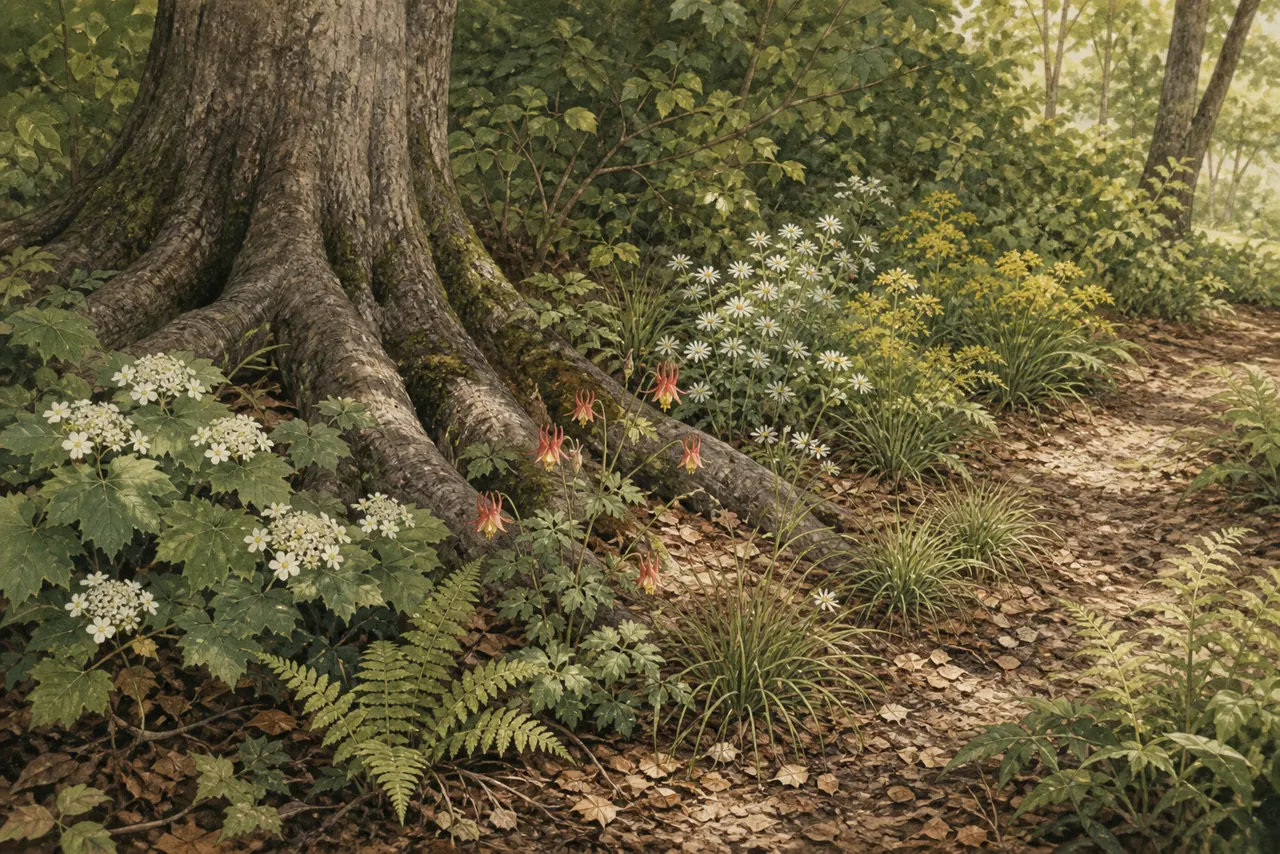
Protect the canopy that creates the garden
The tree is the dominant plant in a dry-shade bed. Its roots may occupy the top several inches of soil well beyond the drip line. Avoid tilling, deep edging, and wholesale soil replacement. Set small plugs into pockets between major roots and spread installation over more than one season if necessary.
A thin layer of whole or shredded leaves moderates temperature and returns organic matter without raising the grade around the trunk. Keep mulch and soil away from the root flare.
Make foliage the default view
Dry-shade flowers are episodic. Build most of the visual field with Pennsylvania sedge and ferns, then repeat columbine for spring and white wood aster or wreath goldenrod for fall. A single mapleleaf viburnum can form the taller back layer where space allows.
This layered approach continues to look planted when flowers are absent. It also reduces the amount of exposed soil where garlic mustard, Japanese stiltgrass, or other weeds can establish.
- Matrix: roughly half to two-thirds low sedge or another compatible ground layer.
- Seasonal accents: repeat two flowering species in visible drifts.
- Structure: one shrub or a small group of ferns, only where mature width is available.
Water where rain cannot reach
A bed beneath an eave may be drier than a woodland, even if the light looks similar. Water new plugs slowly so moisture reaches the root ball, and check beneath the leaf layer rather than judging from the surface. Once established, reduce irrigation gradually and watch the plants through a full summer.
Do not assume that every shade plant tolerates dry soil. Golden ragwort, for example, is better reserved for the cooler medium-moisture pocket rather than the driest root-filled zone.
The working plant palette
These roles are a starting framework. Confirm county-level nativity, provenance, mature width, and nursery availability before purchase.
A fine-textured, low sedge listed for shade to sun and dry-to-moist soil.
Tolerates dry-to-medium partial shade and can seed lightly between rocks and sedges.
White wood aster
Eurybia divaricata
A woodland aster for dry-to-moist shade that brightens the bed late in the season.
Wreath goldenrod
Solidago caesia
Arching stems and small yellow flowers fit a woodland edge without requiring full sun.
Mapleleaf viburnum
Viburnum acerifolium
A compact native shrub option where the bed has room for a three-to-six-foot mature plant.
Marginal wood fern
Dryopteris marginalis
Adds a stable foliage form among sedges and seasonal flowers.
A practical sequence
Map major roots and sun before leaf-out; remove invasive seedlings by hand.
Plant small plugs between roots and water each pocket thoroughly.
Check moisture below leaves during dry spells, especially beneath roof overhangs.
Keep a modest leaf layer, edit path edges, and add fall plugs while soil is workable.
- Never pile soil or mulch against a tree trunk, and do not sever structural roots to fit a garden design.
- A plant being native to Pennsylvania does not mean it naturally occurs in every county or tolerates every woodland condition.
- Penn State Extension — Plant Guide: Shade to Part Shade, Dry to Moist Soil ↗
- Penn State Extension — Mid-Atlantic Shade to Part Shade Plant List ↗
- Penn State Extension — Incorporate Pennsylvania Native Perennials ↗
Plant ranges and recommendations change as records improve. Read how we separate range, site fit, and design judgment in our sources and methodology.