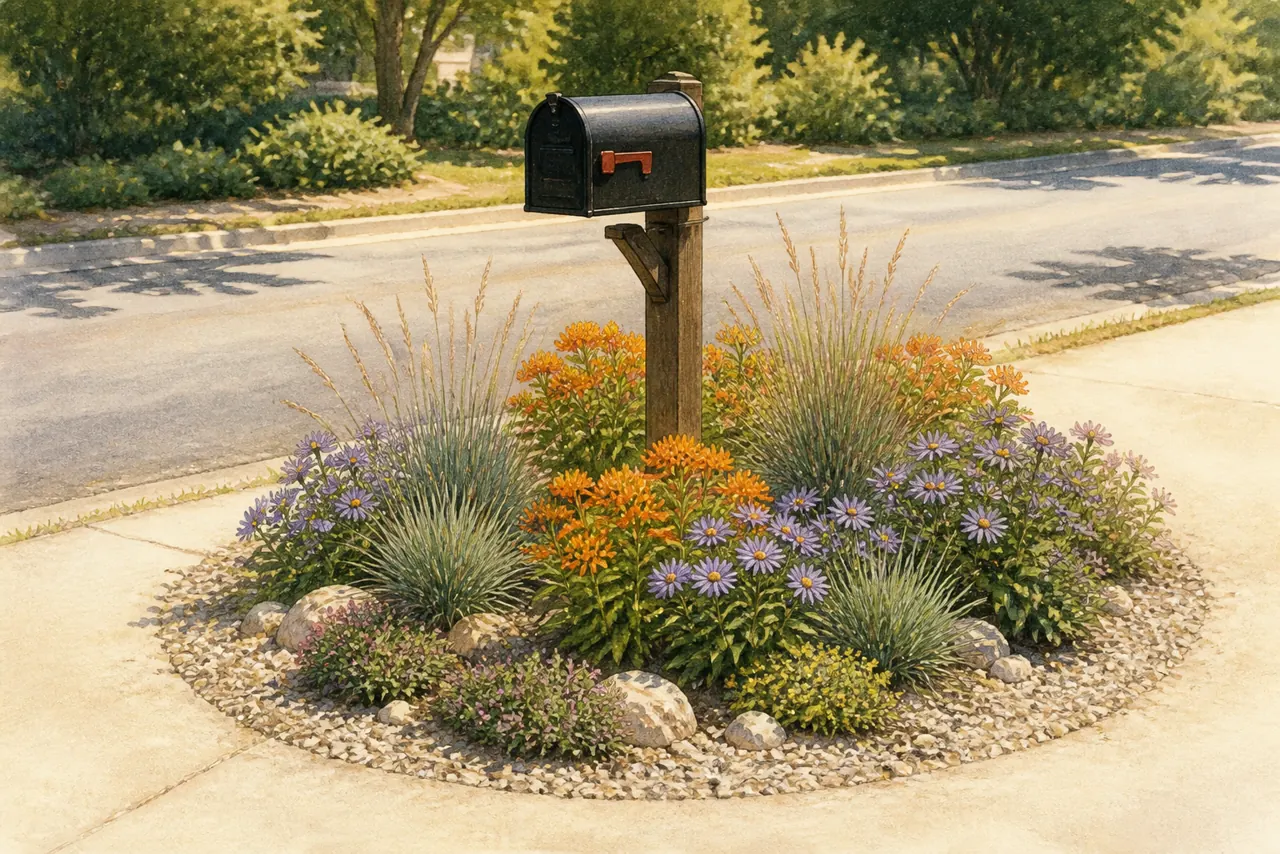
Draw the no-plant zone first
The carrier needs to approach the box without brushing wet foliage, bees, thorns, or leaning stems. Keep the door, post, address, and approach visible. If the mailbox sits near a corner or driveway, preserve the entire traffic sight triangle required by local rules.
A simple crescent or rectangle is easier to edge than a tiny island with many curves. Place the tallest clump behind or beside the post, never directly in front of the address or door.
Use fewer plants than the nursery display suggests
For a 4-by-6-foot bed, repeat butterfly weed and aromatic aster in small groups, add one or two little bluestem clumps, and use beardtongue only if the bed has medium moisture. Mature widths—not pot sizes—determine quantity.
Leave open mineral or mulched space at the road edge during the first year if salt and plowed snow are severe. Replace that edge only after observing which section receives the most damage.
- Road edge: lowest plants or a sacrificial unplanted strip.
- Middle: two repeated flower groups for summer and fall.
- Back: one structural grass, clear of the box door and address.
Expect winter to edit the plan
Road salt can accumulate in splash zones and snow piles. Brown margins or missing plants along one side are useful site information. Move the permanent palette inward and choose salt-tolerant locally native alternatives with extension guidance if damage repeats.
Cut back any stem that interferes with delivery or visibility, even if the rest of the garden remains standing for winter habitat. Function and safety define this small habitat’s boundaries.
The working plant palette
These roles are a starting framework. Confirm county-level nativity, provenance, mature width, and nursery availability before purchase.
A low, clumping milkweed for the hot well-drained side of the bed.
Use one compact clump at the back where winter stems will not block the mailbox.
A lower late bloomer that can be sheared once in June for a tighter form.
Adds an earlier flower window in medium soil, set back from the service route.
Use only where the mailbox receives afternoon shade and the soil is not salt-saturated.
A practical sequence
Confirm property, utilities, delivery approach, snow route, and sight lines.
Create one simple bed shape and a durable clear service strip.
Repeat three low species and add no more than one taller structural type.
After winter, move or replace only the plants that reveal salt or snow conflict.
- Roadside planting may be regulated by a municipality, HOA, postal carrier requirements, or transportation agency.
- No general native-plant list guarantees salt tolerance; local road exposure and soil accumulation differ.
- Penn State Extension — Incorporate Pennsylvania Native Perennials ↗
- University of Maryland Extension — Landscape Designs with Native Plants ↗
- Rutgers NJAES — Incorporating Native Plants in Your Residential Landscape ↗
Plant ranges and recommendations change as records improve. Read how we separate range, site fit, and design judgment in our sources and methodology.