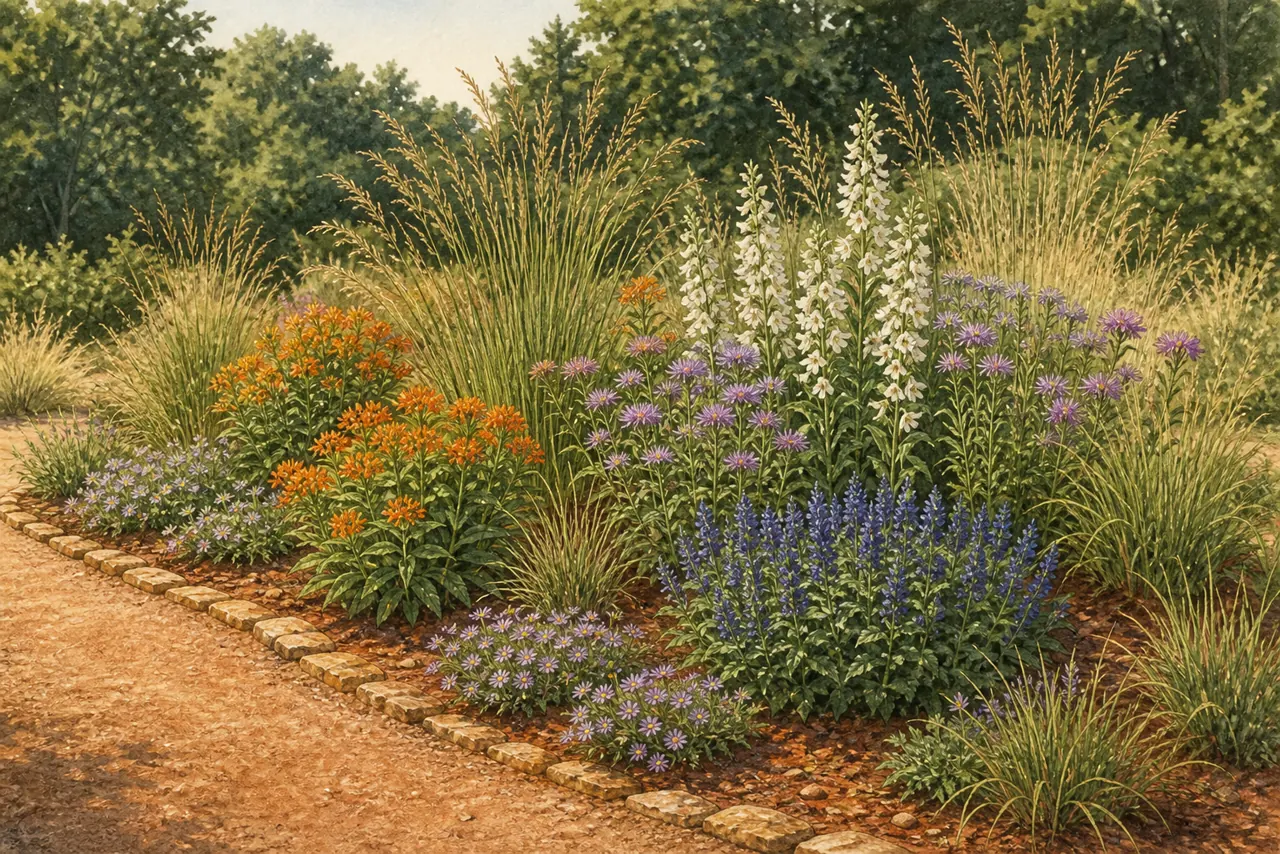
Use a 3–2–1 rhythm
A compact sunny planting feels calmer when one species appears more often than the rest. Start with three repeated clumps of little bluestem, two flower drifts, and one larger anchor such as blue wild indigo. Thread a lower species along the front rather than outlining every individual plant.
This is a design ratio, not a shopping formula. Scale quantities to mature width. A small transplant still needs the same final footprint as a larger pot of the same species.
- Back third: one blue wild indigo, clear of the wall and path.
- Middle: repeated little bluestem, beardtongue, and wild bergamot.
- Front: butterfly weed and aromatic aster in visible groups of three.
Let the calendar do the mixing
Foxglove beardtongue opens in late spring, blue wild indigo and butterfly weed carry early summer, wild bergamot fills midsummer, and aromatic aster closes the season. Little bluestem is present throughout, changing from blue-green leaves to copper stems.
The palette does not need every plant to flower at once. Overlapping two bloom periods at a time gives pollinators continuity and keeps the bed from becoming a short-lived color burst followed by bare mulch.
Manage heat and establishment
Reflected heat beside brick, asphalt, or pale siding can exceed the conditions in an open field. Put the most drought-tolerant choices at that edge, but water new roots consistently through their first season. Drought tolerance describes an established plant, not a newly planted plug.
Cut back only where access or appearance requires it. Standing little bluestem and aster stems supply winter structure; remove damaged material before spring growth begins.
The working plant palette
These roles are a starting framework. Confirm county-level nativity, provenance, mature width, and nursery availability before purchase.
Compact, vivid, and suited to the driest well-drained front edge.
White flower spires start the sequence before most summer perennials.
Provides a broad midsummer nectar window; give its spreading habit a defined boundary.
Fine texture, copper fall color, and standing stems organize the planting after frost.
A long-lived mound for the back third where a four-foot footprint will remain clear.
A low late-blooming mound for the front or corner of a dry sunny bed.
A practical sequence
Measure the bed, mark mature widths, and remove turf without disturbing tree roots.
Plant the anchor and grasses, then fill repeated perennial groups.
Water deeply during establishment and pull weeds before they set seed.
Cut standing stems before new growth; divide or edit only where colonies exceed their boundary.
- The Virginia Piedmont guide covers a broad region; use the Digital Atlas of the Virginia Flora or local extension resources to confirm county records.
- Do not place tall plants where they block a driveway sight line, dryer vent, meter, or service access.
- Virginia DCR — Native Plants for Virginia’s Piedmont Region ↗
- Virginia DCR — Native Plant Finder background ↗
- Digital Atlas of the Virginia Flora ↗
Plant ranges and recommendations change as records improve. Read how we separate range, site fit, and design judgment in our sources and methodology.