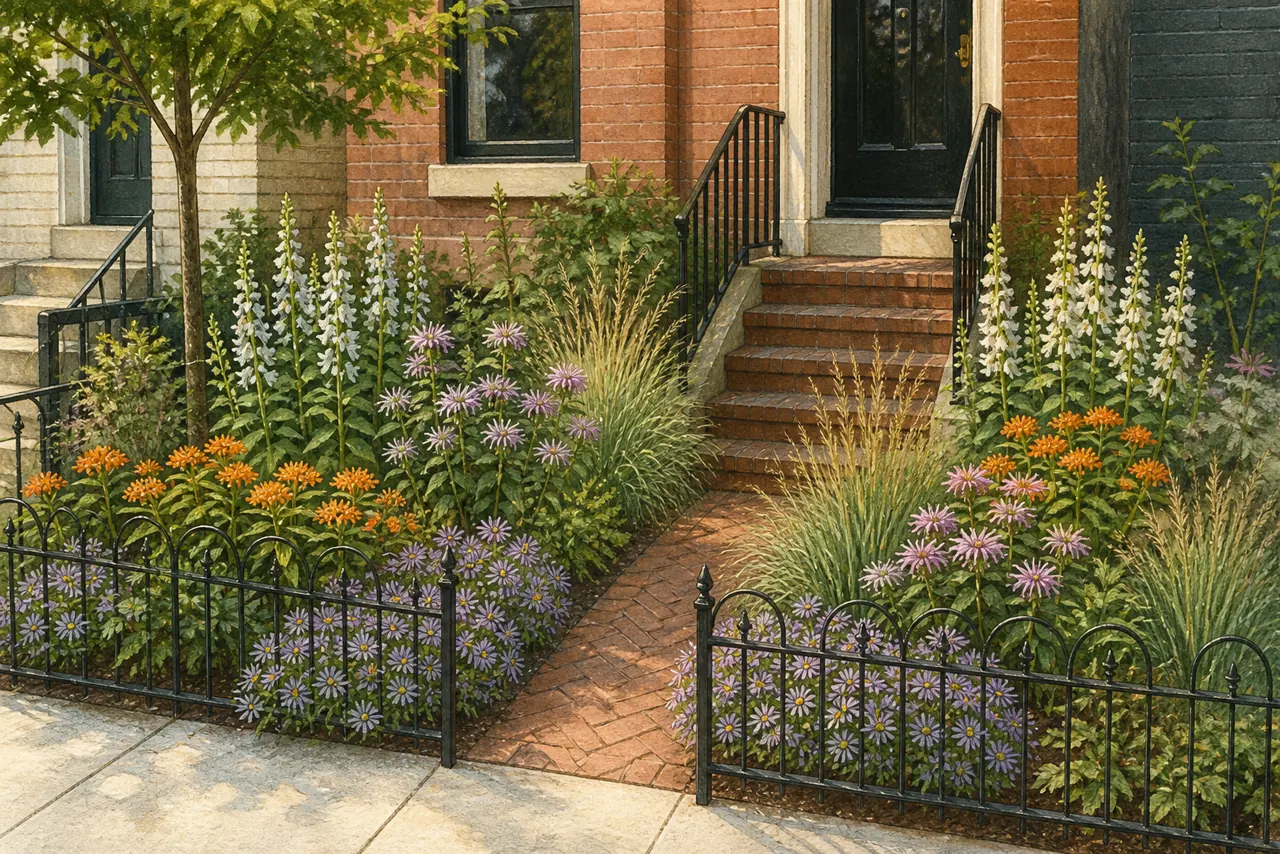
Start with the circulation plan
In a rowhouse front yard, people, deliveries, trash bins, meters, and building access take priority. Draw those routes at their real width before drawing the garden. Keep thorny, floppy, or bee-busy flowers away from the narrowest pinch points and stair handrails.
A crisp edge along the walk gives the planting a civic face. Place the shortest plants at that edge, repeat little bluestem or beardtongue behind them, and concentrate the most active summer flowers a step farther from daily movement.
Choose one sun palette or one shade palette
For six or more hours of direct sun, combine butterfly weed, foxglove beardtongue, wild bergamot, little bluestem, and a compact fall aster. For a tree-shaded exposure with medium moisture, switch to a sedge-and-golden-ragwort ground layer with columbine and woodland asters.
Do not blend the two palettes merely to increase variety. A five-species group repeated across a small space looks more intentional and is easier to manage than fifteen single plants with conflicting moisture needs.
- Front 18 inches: low clumps that do not lean into the sidewalk.
- Middle band: repeat spring and summer flowers in groups, not singles.
- Back or corners: slim grasses or one compact shrub only where windows and meters remain clear.
Support insects without creating a conflict
DC’s Department of Energy & Environment recommends native pollinator plants and a sequence of flowers from spring through fall. Avoid pesticides, leave some stems for overwintering insects, and keep a modest leaf layer where it will not become a slipping hazard.
Add a small sign or a clear plant label if the garden is highly visible. The strongest explanation, however, is good maintenance: a defined edge, an open route, no litter, and prompt removal of invasive weeds.
The working plant palette
These roles are a starting framework. Confirm county-level nativity, provenance, mature width, and nursery availability before purchase.
Included on DC’s native pollinator list and narrow enough for repeated vertical accents.
A DC-listed pollinator plant; place where its spreading habit can be edited from a path.
A clumping grass that keeps form into winter without a large shrub footprint.
Fits the sunniest well-drained pocket and stays lower than many milkweeds.
A compact late-season flower for a sunny front corner.
Use in a separate medium-moist part-shade bed, not in the hot dry palette.
A practical sequence
Draw the building, walk, steps, utilities, tree canopy, and mature plant widths.
Choose either the sun palette or the shade palette after leaf-out observation.
Plant from the building outward so new plugs are not trampled.
Cut back growth at paths, remove invasives early, and retain safe winter structure.
- Public tree boxes, sidewalks, alleys, and rights-of-way may have District rules; confirm what is on your property before changing them.
- Urban soil can contain lead or other contaminants. Use testing and local guidance, especially for edible gardening or exposed bare soil.
- DC Department of Energy & Environment — Plant a Pollinator Garden ↗
- DC Department of Energy & Environment — Native and Invasive Pollinator Plants ↗
- DC Department of Energy & Environment — Native Plants ↗
Plant ranges and recommendations change as records improve. Read how we separate range, site fit, and design judgment in our sources and methodology.