Separate erosion from instability
A few shallow rills and exposed soil after rain are different from a bank that is moving. Deepening gullies, new cracks, tilted trees or walls, and saturated soil above a structure are warning signs. Planting advice is not engineering advice; seek qualified local assessment when the land or a structure may be unstable.
On a stable slope with ordinary surface erosion, the practical goal is continuous cover. Avoid clearing and tilling the whole grade at once. Work in small pockets, keep undisturbed vegetation between them, and protect bare soil immediately.
Plant across the contour
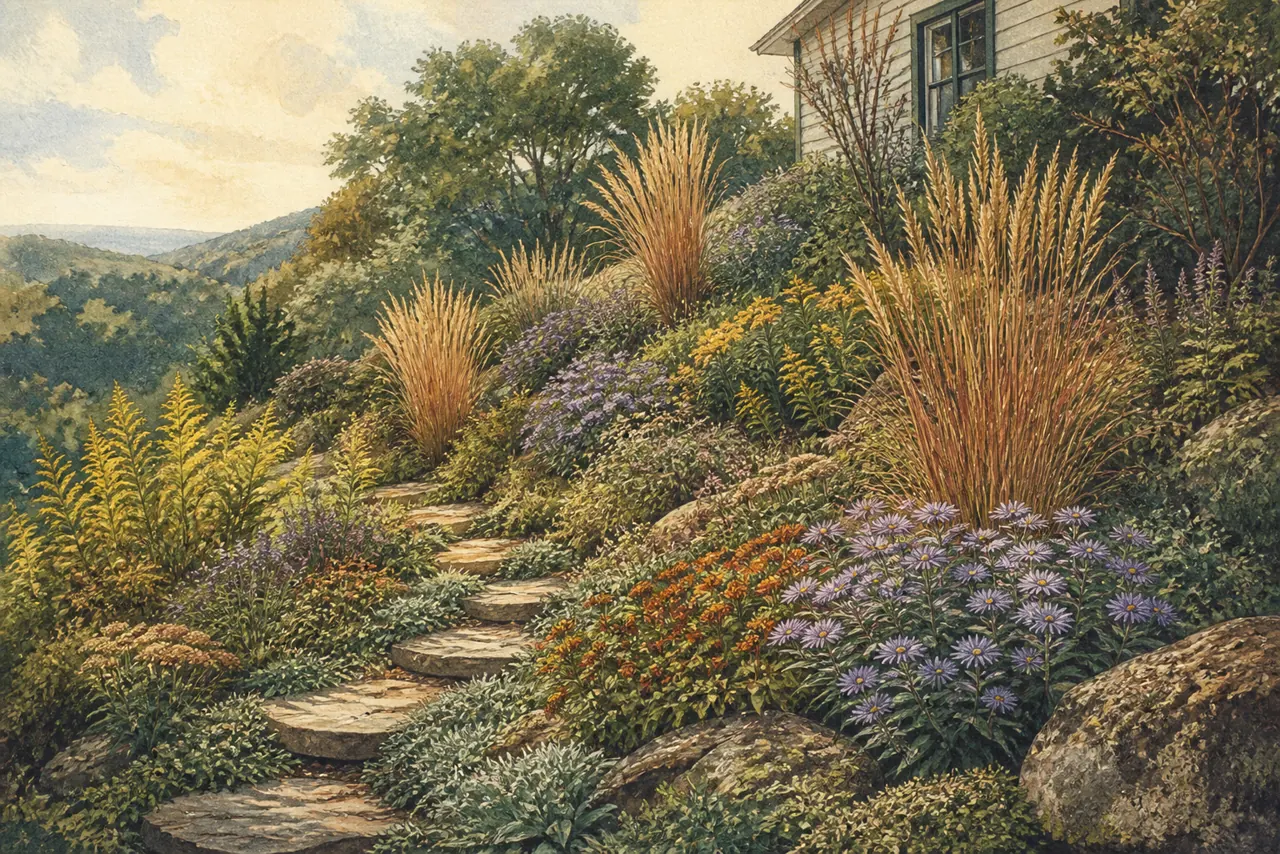
Arrange repeated bands or staggered groups across the slope rather than channels running downhill. Little bluestem can structure a sunny upper slope; Pennsylvania sedge can form a lower woodland-edge layer. Add beardtongue or aster between matrix plants for seasonal flowers.
At the toe, only use moisture-tolerant plants if water spreads and drains safely. Concentrated runoff should be redirected or dissipated through an appropriate drainage design before a plant palette is expected to hold the soil.
- Upper shoulder: drought-tolerant clumping plants with open-sun exposure.
- Middle slope: dense repeated matrix with small flowering pockets.
- Toe: moisture-compatible groundcover or shrub only where water does not threaten a structure.
Use temporary protection while roots grow
New plugs do not stabilize a slope on planting day. Use an appropriate biodegradable erosion-control blanket, coir log, leaf layer, or other locally recommended surface protection where needed, installed so it does not redirect water into a new channel.
Water slowly at each plant rather than sending a hose stream down the grade. Inspect after storms, reset exposed roots, and fill small bare gaps before they become flow paths.
The working plant palette
These roles are a starting framework. Confirm county-level nativity, provenance, mature width, and nursery availability before purchase.
A clumping warm-season grass for dry-to-medium open ground.
A low ground layer for drier woodland-edge conditions.
A rooted clump for medium soil with late-spring bloom.
A lower late-season mound for a stable, well-drained sunny area.
Useful in a cooler lower pocket where medium-to-moist soil supports a spreading ground layer.
A moisture-tolerant woody anchor for a broad stable toe with sufficient mature space.
A practical sequence
Rule out slope movement, structural failure, concentrated runoff, and unsafe access.
Cover bare soil and preserve existing roots before adding new plants.
Install staggered groups across the contour with minimal soil disturbance.
Check after major storms and repair small exposed areas before rills deepen.
- Seek qualified help for a sliding bank, active gully, retaining-wall problem, foundation threat, roadway runoff, or steep unsafe work area.
- West Virginia’s elevation, geology, and local flora vary sharply; verify county and site fit before ordering plants.
- WVU Extension — Planning Your Garden ↗
- WVU Extension — Conduct a Soil/Site Review ↗
- WVU Extension — Invasive Species in Your Landscape ↗
Plant ranges and recommendations change as records improve. Read how we separate range, site fit, and design judgment in our sources and methodology.