By Pocket Habitat · revised September 12, 2026
These are source-informed editorial layouts, not gardens we claim to have installed or field-tested. Coordinates describe this example; local conditions and nursery dimensions take priority.
Does your site fit?
A 6-foot-diameter planting envelope on private property beside a mailbox approach, not in the carrier's required approach or a road visibility area. Only the far half is planted; the near half stays available for access.
The planting recipe
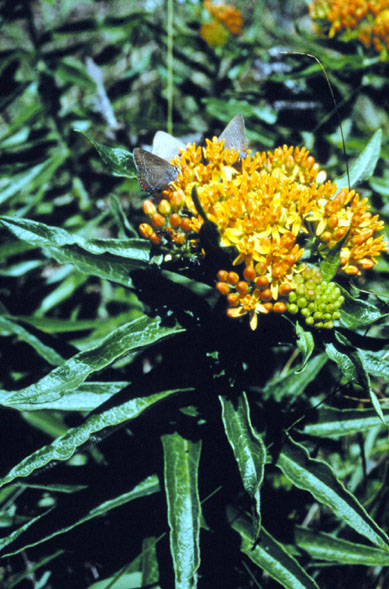
Place three butterfly weeds roughly 2 feet apart in the far semicircle. Reserve up to 18 inches of width for each based on the cited species profile, then check the actual nursery selection. Their height still requires a visibility check; this drawing is not a certification of road or postal clearance.
| Plant | Qty. | Role |
|---|---|---|
| Butterfly Weed | 3 | B · far semicircle; keep access half unplanted |
How to lay it out
- Mark a circle with a 3-foot string, only after locating an approved planting envelope. The mailbox post and its concrete footing are not included in the usable six-foot circle; keep them outside it.
- Use the enclosing square's far-left corner (top left on the diagram) as the measuring origin. Place plants at (1.3, 2.2), (3, 1.2) and (4.7, 2.2) feet, with the near access side at the bottom of the diagram. Rotate the whole arrangement only if the unplanted half still faces the approach.
- Keep the access half firm, unobstructed and free of trip hazards. Do not install stakes, rocks or raised edging where a person or vehicle needs to pass. If permitted access requires more space, move the planting rather than narrowing it.
- Plant in draining soil at the root-ball depth. Label crowns for spring and check root-ball moisture during establishment. Avoid routine fertilizer; this is a small summer-flowering patch, not a dense hedge.
- Check actual overhang with the mailbox door open and after rain bends stems. Remove obstructions promptly. At season's end, keep only stems that remain clear of access and snow operations.
Season by season
Refresh a narrow mulch edge until plant crowns knit together.
Keep growth clear of the mailbox door and street sightline.
Retain only stems that do not obstruct access, snow removal or the sidewalk.
If the planting does not behave as expected
Plants are hit by snow or road runoff
Relocate the planting outside the operational strip. A native label does not guarantee tolerance of plowed snow, road salt or repeated vehicle damage.
A three-plant bed looks sparse
The empty area is functional access space. Do not fill it with extra plants merely to make the ring look complete.
Soil remains wet
Butterfly weed is a drainage-sensitive choice. Use another location instead of filling its planting hole with gravel or guessing that a wet-site plant solves the access problem.
Before purchasing
Open each plant field card, verify regional range, and ask for straight species or locally appropriate cultivars. Availability and local native status vary. If your site differs substantially, use the plant finder to rebuild the list around the actual conditions.
Read the related site-preparation guide before buying, or compare the other Garden Plans.
Sources and design decisions
The sources below support plant size and culture, not an endorsement or trial of this layout. Coordinates, quantities and access allowances are our editorial design decisions. Consult local guidance for your property.