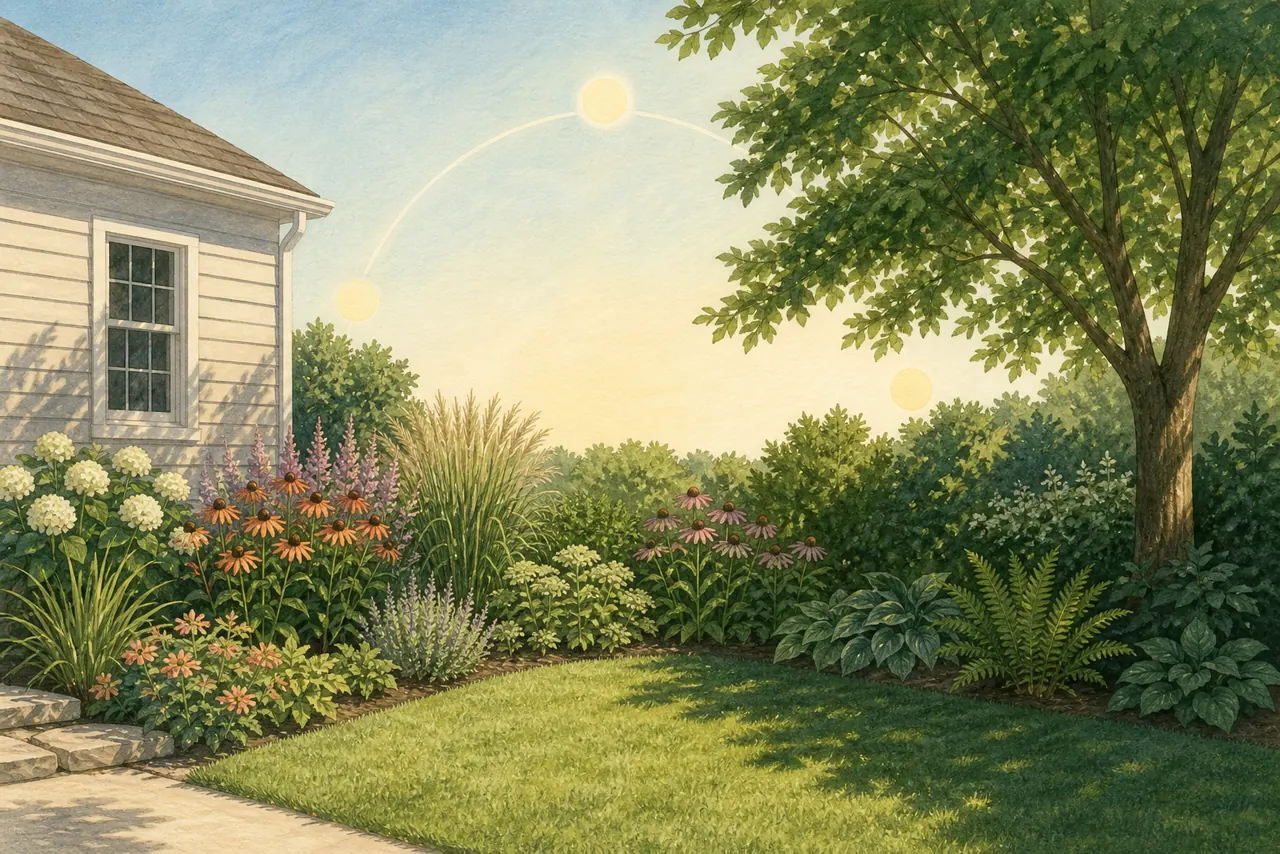
Plant tags compress a changing light pattern into three labels: full sun, part sun, and shade. Those labels become useful only after you know how many hours of direct light reach the actual planting area, when that light arrives, and whether a wall or paved surface adds reflected heat. A south-facing label on a real-estate plan is not a sun measurement; a neighboring house, porch roof, fence, or mature tree may control the bed.
Prepared by Pocket Habitat · reviewed against University of Maryland Extension guidance · editorial method
Choose a representative observation day
Use a mostly clear day after nearby deciduous trees have leafed out. For a spring planting decision, a late-spring or early-summer reading is more representative than a February reading made through bare branches. The goal is not laboratory precision. It is to separate genuinely sunny pockets from bright-looking areas that receive little direct sun.
If the bed runs along a wall or beneath a canopy, divide it into two or three zones before you begin. A six-foot-deep foundation bed can have direct sun at the lawn edge while the soil beneath the eave remains shaded and dry. Record each zone separately instead of averaging the entire bed.
Make a one-day light map
- Sketch the bed, nearby buildings, tree trunks, fences, and the direction of north.
- Mark three representative points: usually the front edge, center, and back or wall side.
- Check the points about every two hours from morning through early evening. Record direct sun, open bright shade, or deep shade.
- Note the first and last direct-sun time for each point and add only the intervals when the sun itself reaches that point.
- Write down whether the direct light is mostly morning, midday, or late afternoon.
| Time | Front edge | Center | Wall side |
|---|---|---|---|
| 8 a.m. | Direct / bright / deep | Direct / bright / deep | Direct / bright / deep |
| 10 a.m. | Direct / bright / deep | Direct / bright / deep | Direct / bright / deep |
| Noon | Direct / bright / deep | Direct / bright / deep | Direct / bright / deep |
| 2 p.m. | Direct / bright / deep | Direct / bright / deep | Direct / bright / deep |
| 4 p.m. | Direct / bright / deep | Direct / bright / deep | Direct / bright / deep |
| 6 p.m. | Direct / bright / deep | Direct / bright / deep | Direct / bright / deep |
How to add up separate hours of sunlight
For each marked point, add the lengths of its direct-sun windows, not the time between the first and last sighting. For example, imagine that you observe direct sun from 8:30 to 10 a.m. and again from 1 to 3:30 p.m. The first window is 1.5 hours and the second is 2.5 hours: 1.5 + 2.5 = 4 hours of direct sun. The shaded interval between them does not count. This is an illustrative calculation, not a measurement from a tested garden.
Two-hour spot checks give a rough map, not exact start and finish times. If a point is sunny at 10 a.m. and shaded at noon, the change occurred somewhere between those checks. Revisit around that transition more frequently—for example, every 15–30 minutes—when the result is close to a plant’s light requirement. Keep uncertain intervals marked as estimates rather than assigning two full hours to each sunny observation.
The same total can arrive in different patterns. Record the windows alongside the sum so that a plant needing protection from afternoon heat is not selected solely from the number four. Repeat a borderline observation on another representative clear day before buying plants for the whole bed.
Count direct light, not a bright sky
Open shade can look bright because it receives light from the sky, but it is not the same as direct sun. Look for a distinct shadow with a clear direction. A soft, faint shadow beneath a bright overcast sky should not be counted as direct-sun time. Dappled light beneath moving leaves is best recorded as dappled rather than rounded up to full sun.
University of Maryland materials use a practical growing-season framework: full sun is at least six hours of direct light, partial shade is roughly three to six hours, and shade is less than three hours of direct light or filtered light. Nursery labels vary, so treat those thresholds as a screening tool and then read the plant-specific description.
Account for seasonal change
A single day is a useful baseline, not a permanent certificate. The sun is higher in summer, deciduous canopies close after spring, and neighboring trees grow or are pruned. A bed beneath a deciduous tree may receive strong spring light before leaf-out but become shaded during summer. That pattern can suit spring ephemerals, yet it should not be described simply as full sun.
Recheck a questionable bed near the summer solstice and again after full leaf-out. Repeat the map after major pruning, construction, fence installation, or tree loss. Photographing the same view at the same times can make the change easier to compare.
Turn the map into a planting decision
Keep the zones instead of forcing the whole bed into one label. A sunny, dry front edge may fit butterfly weed or little bluestem, while a cooler part-shade pocket may call for a different palette. Next, combine the light map with drainage, moisture after rain, mature plant width, and access requirements.
- Use the plant finder to filter by the measured light and observed moisture.
- Compare the footprint with a measured garden plan rather than choosing plants before measuring the bed.
- For a canopy edge, continue with the Pennsylvania dry-shade guide.
- If the bed is against a building, check the access and eave cautions in the narrow foundation-bed guide.
Common measurement mistakes
- Using a phone compass alone: orientation cannot account for buildings, canopy, or topography.
- Checking only at noon: a narrow midday window can hide a long morning or afternoon shadow.
- Measuring before leaf-out: the result can greatly overstate summer light beneath deciduous trees.
- Ignoring reflected heat: a pale wall, masonry, or pavement may make a technically part-sun pocket hotter and drier.
- Averaging the whole bed: small gardens often contain the sharpest light transitions.
What this method cannot tell you
The map does not measure soil moisture, drainage, wind, root competition, salt exposure, or the thermal effect of hard surfaces. It also does not confirm that a species is native to your county. Use the result as one layer of a site profile, then verify range and the plant’s full cultural requirements before purchase.
- University of Maryland Extension — Rain Gardens Across Maryland: sunlight definitions ↗
- University of Maryland Extension — Seeing the Light of Day ↗
Thresholds organize observations; they do not replace species-specific requirements or local range verification. See Sources & Methodology.