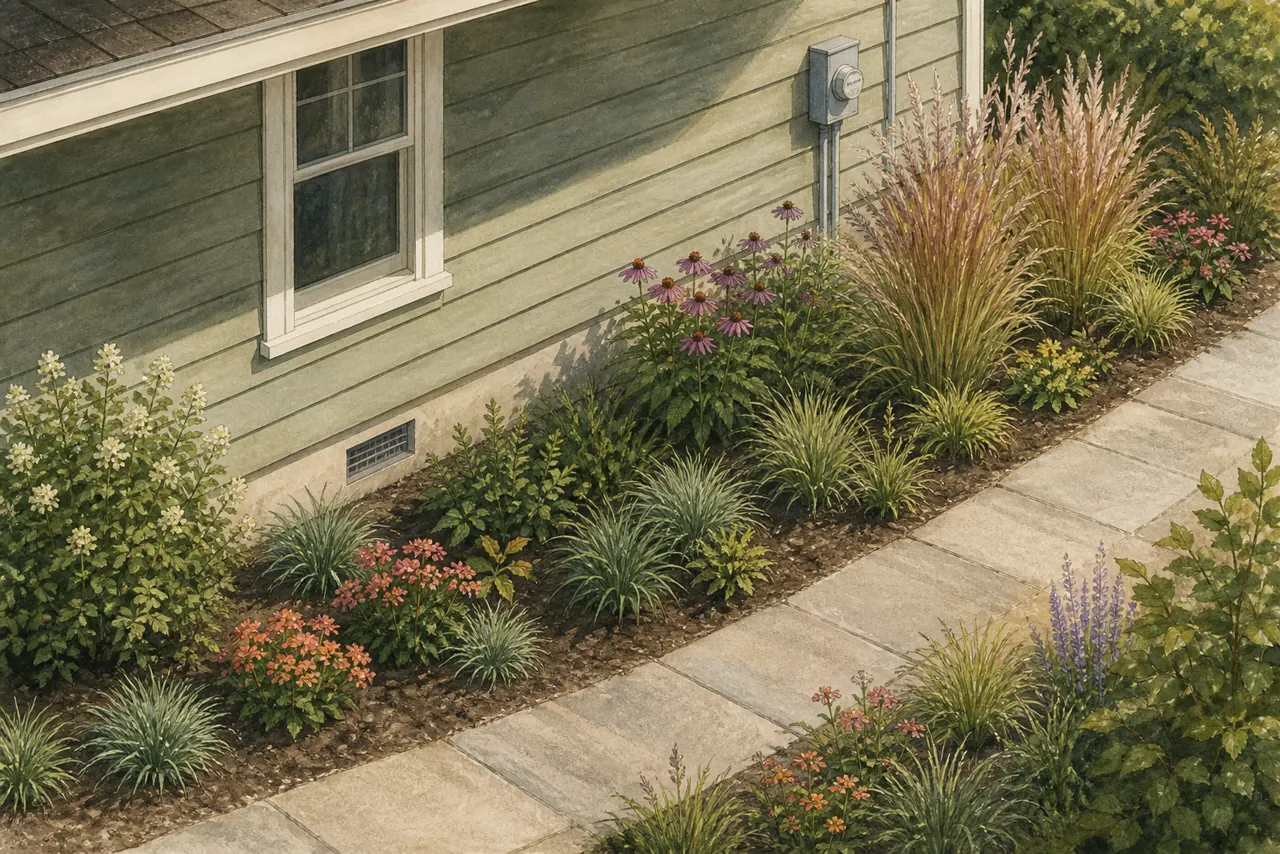
Measure the usable strip, not the mulch line
Begin with the distance from the house to the walk or lawn, but do not call all of it planting space. Mark the route to the hose bib, meter, exterior outlet, cleanout, heat-pump service panel, and any window that could be used for emergency egress. Keep plant crowns, arching stems, and winter seedheads out of those working zones. A neat drawing that ignores access will become a pruning problem as soon as the plants mature.
Sketch every candidate at its expected mature width, not at nursery-pot size. Virginia Cooperative Extension identifies oversize foundation shrubs as a common mistake because plants below windows and near entries eventually require repeated size-control pruning. In a strip that retains only two feet of usable width after clearances, a sedge or small-perennial matrix is more realistic than any woody screen. A wider corner can hold a larger accent, but the narrow run should stay low and repeatable.
- Measure the narrowest point, including path overhang and door swing.
- Set a maximum plant height below windows, labels, and vents.
- Leave a visible service route instead of planning to cut one later.
Treat each wall exposure as a different site
A south- or west-facing wall can reflect enough heat and light to make a small bed behave hotter and drier than the rest of the yard. A north-facing wall may be cool but not uniformly moist, and an east-facing wall may receive a useful band of morning sun. University of Maryland Extension notes that reflected heat and light from hard surfaces can change how exposure feels to plants. Count direct light on foliage after nearby trees leaf out, then compare the wall edge with the outer edge of the strip.
Roof geometry creates a second gradient. Soil under deep eaves may stay dry through ordinary rain while a downspout outlet saturates one small point. Do not solve that contrast by turning the foundation bed into a rain garden. University of Maryland's small-space Bay-Wise guidance directs downspout water at least ten feet away from the house to reduce wet-basement and foundation risk. Persistent dampness, standing water, or erosion beside the building is a drainage problem to assess before planting.
- Hot wall plus six or more hours of direct sun: use the sunny, well-drained palette.
- Morning sun or open part shade with dry-to-medium soil: use the sedge-and-columbine palette.
- Wet wall edge or recurring basement moisture: pause planting and correct the water source first.
Build a sunny strip from compact repeated groups
For a well-drained strip roughly four feet wide, place little bluestem in the outer half as the repeating frame. Thread butterfly weed through the driest front pockets, use foxglove beardtongue where the soil holds a little more spring moisture, and reserve aromatic aster for one or two fall groups with enough room to form low mounds. Keep the tallest stems away from windows, dryer vents, and the path's shoulder.
A twelve-by-four-foot bed might begin with three little bluestem clumps and three small flower groups, but plant count is not a fixed recipe. Recalculate from the mature dimensions of the exact species or cultivar available locally. Omit blue wild indigo from the narrow run even though it is an excellent Mid-Atlantic perennial: its shrub-like mature footprint belongs in a wider corner or freestanding bed, not a slot that depends on annual cutting to stay passable.
Use a low matrix for part shade
In dry-to-medium part shade, repeat Pennsylvania sedge as the main ground layer and place eastern red columbine in small spring groups between it. Foxglove beardtongue can occupy the brighter outer edge. Use golden ragwort only where observation confirms a cooler medium-moisture pocket; directly beneath rain-blocking eaves, it may be a poor fit even though the wall faces north.
This palette should read as two or three repeated species, not a sampler of single plants. Rutgers NJAES recommends assessing soil, available water, sunlight, mature size, and growth habit for each space before selection. That discipline matters in a narrow bed because a spreading colony can close a service route quickly. Decide in advance where each species may spread and where the clean edge must hold.
Establish the bed without creating a shearing schedule
Start with plugs or small containers when possible so roots can be placed without over-excavating a tight, utility-filled strip. Test the soil before adding fertilizer or changing pH. If the bed needs organic matter, improve the planting area consistently rather than making isolated soft pockets. Use no more than a modest mulch layer while plants establish, and keep mulch, soil, and stems away from siding and openings.
Water new plants according to weather and actual soil moisture through the first growing season. Then replace routine shearing with a simple editing rule: remove growth that blocks access, crosses the path, traps against the wall, or escapes the intended group. Retain safe seedheads and stems through winter, cut them before new growth, and review the plan after one hard rain and one midsummer dry spell each year.
The working plant palette
These roles are a starting framework. Confirm county-level nativity, provenance, mature width, and nursery availability before purchase.
A low, fine-textured ground layer for a part-shade strip where roots will not remain wet; use repeated plugs rather than isolated tufts.
Fits between sedge groups in dry-to-medium part shade and adds an early flower without creating a bulky permanent mass.
Useful only in the cooler, medium-moisture end of a shaded strip; it is not the choice for the rain-starved soil directly under deep eaves.
Narrow clumps give a hot, well-drained strip rhythm and winter stems without the permanent bulk of a shrub hedge.
Its lower habit and preference for well-drained sun suit the outer edge away from roof runoff and dense shade.
A low fall-blooming mound can finish the sunny palette where its mature spread will not narrow the walk.
White late-spring spires bridge the two palettes in a brighter dry-to-medium pocket, while the basal foliage remains relatively low.
A practical sequence
Map access, wall exposure, roof rain shadow, downspouts, and the strip's narrowest usable width.
Draw mature plant widths and choose either the sunny or part-shade palette for each distinct zone.
Install the repeated matrix first, then add only the seasonal groups that fit the remaining space.
Water for establishment, keep the service route open, and photograph the bed in wet and dry weather.
Cut safe stems before new growth and edit spread without shearing every plant into the same shape.
- A planting cannot repair failed grading, a leaking foundation, or a downspout that discharges against the house. Address persistent moisture or erosion before installing the bed.
- Keep required clearance around HVAC equipment, meters, vents, electrical service, egress windows, and utility access; follow manufacturer and local requirements.
- County-level native status, provenance, and nursery stock vary across the Mid-Atlantic. Verify the exact plant before purchase.
Continue planning
- Filter plants for the measured conditions: Use the Plant Finder to narrow the library by light and soil moisture.
- Adapt the Sunny Postage Stamp plan: Borrow its repeated groups for a wider sunny section without copying the footprint blindly.
- Measure sunlight before choosing a palette: Use a one-day observation method after nearby trees leaf out.
- Keep a public-facing bed intentional: Add visible edges, repeated structure, and a written editing rule.
- University of Maryland Extension — Landscape Designs with Native Plants ↗
- University of Maryland Extension — Bay-Wise Yardstick for Small Space Urban Gardens ↗
- Rutgers NJAES — Incorporating Native Plants in Your Residential Landscape ↗
- Virginia Cooperative Extension — Selecting Plants for Virginia Landscapes: Showy Flowering Shrubs ↗
- USDA NRCS — PLANTS Database ↗
Plant ranges and recommendations change as records improve. Read how we separate range, site fit, and design judgment in our sources and methodology.