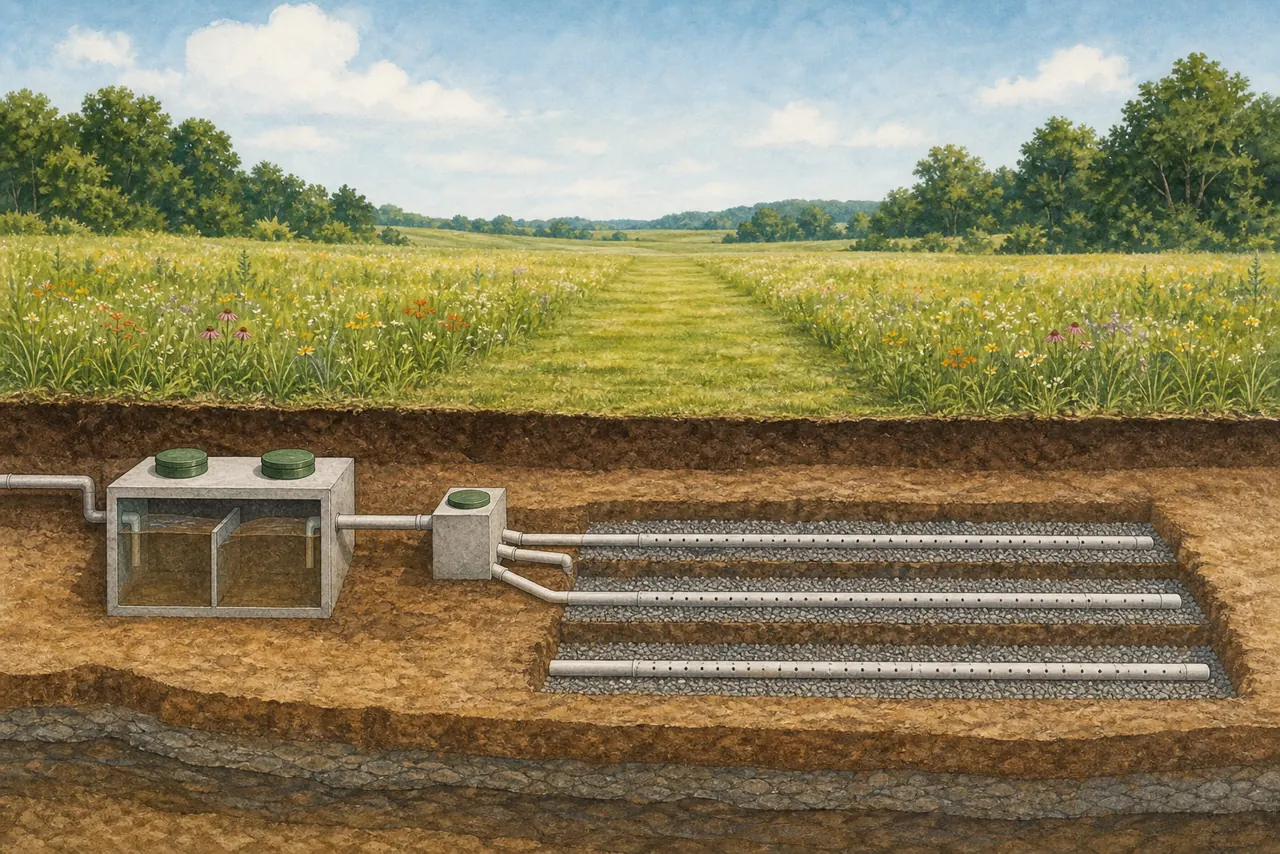
Map the wastewater system before drawing a garden
Start with records, not a shovel. A septic property may include a tank, distribution box, absorption trenches, inspection ports, a raised mound, and an undisturbed reserve area for a future replacement field. Their locations and depths vary. Ask the county health department, permitting office, installer, or septic service professional for the as-built plan and field markings. Do not infer pipe locations from greener grass or from the tank lid alone.
Keep permanent access visible. A planting that covers a lid, inspection port, or route for pumping equipment can delay maintenance and may be damaged when the system is serviced. Mark those clear zones on the plan before assigning plant groups. If the records and the ground disagree, pause the landscape project until a qualified professional resolves the layout.
Protect treatment conditions instead of changing them
The drainfield depends on soil, air, and controlled wastewater movement. EPA guidance says to keep vehicles and heavy equipment off the field, avoid impermeable surfaces, and route roof drains, sump pumps, and other rainwater away. Do not turn a drainfield into a rain garden, add a pond, install a patio, or send a downspout toward it. Extra water can slow or stop treatment, while compaction can damage pipes and reduce infiltration.
Avoid reshaping the surface, building raised beds, adding a deep layer of fill, or installing irrigation lines. Those changes can alter evaporation, oxygen exchange, loading, and service access. Odor, surfacing effluent, unusually wet soil, sewage backup, or a sudden band of lush growth is not a cue to choose a wetter plant. Keep people and pets away from the affected area and contact the local health authority or a licensed septic professional.
- Keep runoff and routine irrigation off the treatment and reserve areas.
- Keep vehicles, construction materials, play equipment, fire pits, and storage off the field.
- Keep lids and the service route open even when the planting is at mature size.
Choose a cover by root behavior and maintenance
University of Maryland Extension identifies turfgrass, grasses, and shallow-rooted native flowers as acceptable drainfield covers, while EPA describes native grasses and groundcovers as the most appropriate categories. That is a category-level starting point, not approval of every native plant. Trees and shrubs have woody roots that can reach and damage lines; food crops add a potential exposure route if the system fails. Keep both off the drainfield unless the responsible local authority gives different written guidance for the exact system.
Favor herbaceous plants that remain low, tolerate the site's existing rainfall after establishment, and can be maintained without frequent division or deep digging. Reject a candidate if its roots, mature size, water demand, aggressive spread, or installation method conflicts with the system plan. When in doubt, use the simple grass cover favored by local guidance and place the more diverse pollinator garden beside—not over—the marked field and reserve area.
Build a restrained Mid-Atlantic palette
For a sunny, dry surface, a repeated clumping grass can supply most of the cover, with small groups of herbaceous flowers for seasonal change. Little bluestem is a candidate only where native grasses are accepted and its mature height will not hide access. Foxglove beardtongue can add a spring flower, and aromatic aster can provide a lower fall group at the edge. In open part shade, Pennsylvania sedge can be screened as a lower matrix candidate. Confirm local nativity and the exact plant's habit before purchase.
Do not copy this palette as a fixed recipe. A conventional trench field, a sand mound, and an advanced treatment system can require different clearances and surface treatment. Use the fewest species needed for continuous cover, repeat them in broad readable groups, and leave a grass-only or unplanted service path where equipment will approach. Put taller habitat layers, shrubs, milkweeds with substantial taproots, and plants that need regular division in a separate bed outside the marked system and reserve area.
- Sun: screen a low grass matrix with two restrained herbaceous flower groups.
- Part shade: screen a low sedge matrix before adding any seasonal accent.
- Mound or unfamiliar system: use only the cover and installation method approved for that design.
Install lightly and keep maintenance reversible
If planting is permitted, use small plugs placed by hand in locations cleared by the system plan. Avoid tilling, trenching, augers, deep edging, landscape fabric, and stakes that could reach a component. Move plants and tools without a loaded vehicle or heavy cart. Preserve the existing grade and follow any limits on added topsoil or mulch. A thin temporary mulch or approved erosion-control material may help during establishment, but a permanent impermeable layer does not belong over the field.
Water individual new plugs only as needed for establishment and only if the septic professional or local authority allows it; do not install permanent irrigation. After establishment, edit spread by hand at visible boundaries and use lightweight equipment if mowing is part of the approved plan. Review the field after storms and before each service visit. The planting succeeds when it protects continuous vegetative cover while making the system easier—not harder—to inspect and maintain.
The working plant palette
These roles are a starting framework. Confirm county-level nativity, provenance, mature width, and nursery availability before purchase.
A low herbaceous sedge for a dry-to-medium, partly shaded surface; confirm that its spreading habit and the planned installation method are acceptable for the marked field.
A clumping native grass for a dry sunny cover where the local authority or septic professional accepts native grasses over this system type.
A herbaceous spring vertical for a sunny-to-part-sun dry-to-medium surface; use only after confirming shallow installation depth and mature height fit.
A lower late bloomer for a sunny edge, provided its mature spread can be edited by hand without repeated digging over the field.
A practical sequence
Collect records and have the tank, lines, field, reserve area, lids, and service route marked.
Ask the local authority or septic professional what cover and installation method the exact system permits.
Remove woody, edible, water-loving, deep-rooted, or high-maintenance candidates from the list.
Use approved small plugs by hand without tilling, grading, trenching, or adding irrigation.
Keep lids and routes visible, minimize traffic, and respond to wetness or odor as a system warning.
- This guide is landscape planning information, not approval for a particular septic design. Local health and permitting requirements and the system professional's instructions take precedence.
- Do not plant trees, shrubs, vegetables, or other food crops over the drainfield or reserve area, and do not build a rain garden there.
- Never probe, dig, drive stakes, or excavate until the system components and utilities have been located.
- Odor, ponding, surfacing wastewater, backup, or persistent saturated soil needs professional assessment, not a planting change.
Continue planning
- Filter the plant library by the surface conditions: Use the Plant Finder for light and moisture, then apply the drainfield safety screen before choosing anything.
- Put a full Garden Plan outside the system: Use the plan library in unencumbered yard space where roots, digging, and long-term access are not constrained by wastewater infrastructure.
- Place a rain garden away from septic infrastructure: Use this adjacent guide only after selecting a separate safe drainage location outside the tank, field, and reserve area.
- Give the low cover a legible edge: Repeat a small palette and preserve a visible service route without adding structures over the field.
- University of Maryland Extension — FAQs on Septic Systems ↗
- University of Maryland Extension / Virginia Cooperative Extension — Planting Over Your Septic Drain Field ↗
- Penn State Extension — Five Basic Practices to Protect Your Septic System ↗
- U.S. EPA — How to Care for Your Septic System ↗
- U.S. EPA — Proper Landscaping On and Around Your Septic System ↗
Plant ranges and recommendations change as records improve. Read how we separate range, site fit, and design judgment in our sources and methodology.