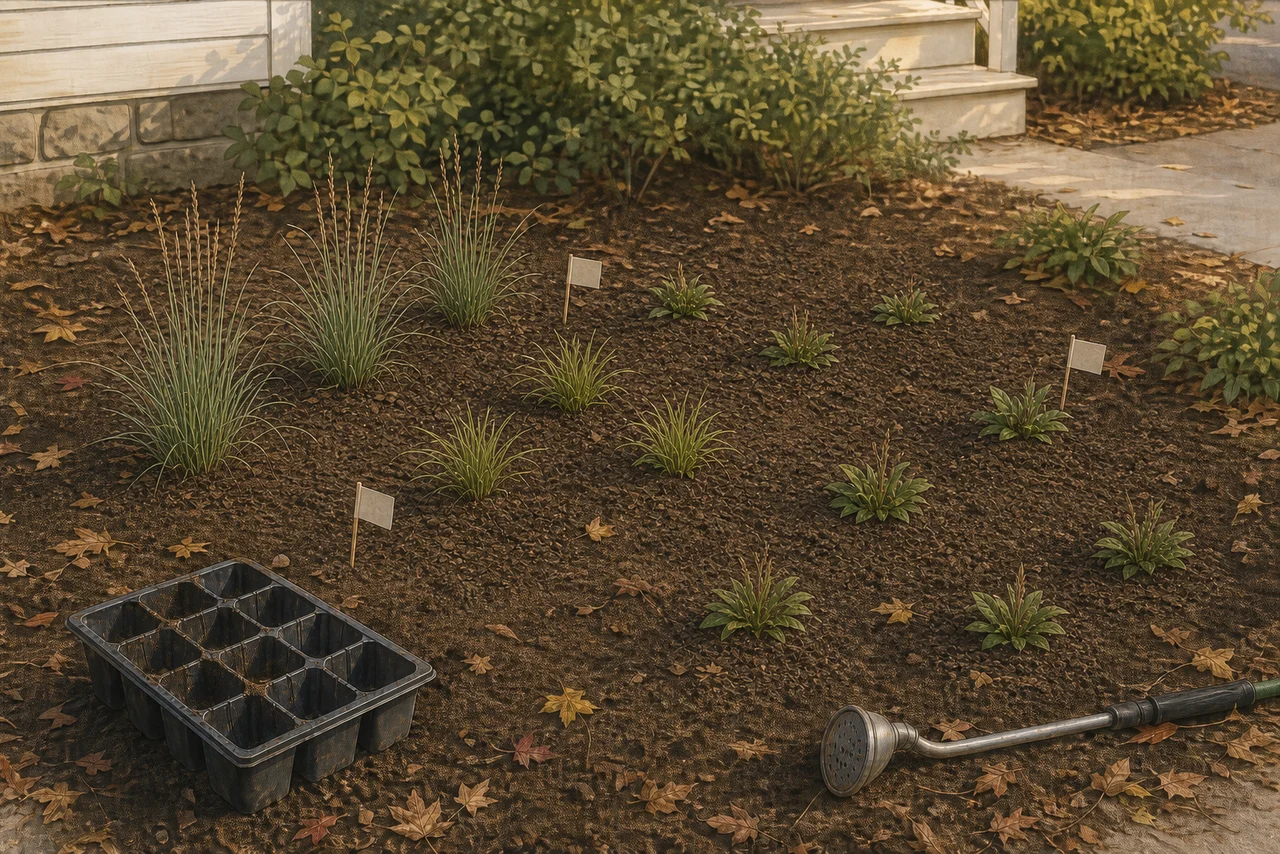
Start with a check, not an inch-per-week target
University of Maryland Extension recommends monitoring moisture and rainfall and grouping plants by water needs. Its general landscape watering figures depend on plant type, growth stage, weather and soil; they are not a quota to add after every storm. Wind and warmth also change water use. An exposed street-side pocket and a sheltered rowhouse border can need different attention on the same day.
Use a simple observation sheet with four columns: location, moisture found, action, next check. For example, write 'front corner: damp, skipped' rather than 'Tuesday: watered garden.' This is a suggested record format, not a tested watering schedule. It lets you notice whether you are treating the whole bed as one unit when your observations say otherwise.
After rain, compare the planting pocket with its surroundings
Move loose mulch aside and gently feel soil near the edge of a new plant's root ball, avoiding the stem and visible roots. Compare with a nearby unplanted spot at a similar depth. Do not judge only the top of the mulch, and do not repeatedly excavate the plant to inspect it. If you cannot safely reach the rooting area, ask the nursery how to check that particular plug or container-grown plant.
Make the comparison in more than one location. A rain gauge records rain where it stands, not moisture inside every planting pocket. If a roof overhang shelters one group, label that group separately in your notes. If water has collected in a depression, do not assume that the exposed uphill edge is equally wet.
- Moist soil at the new roots: skip additional water and check again as conditions change.
- Dry soil at the new roots: water that group gently, then verify that water reached the intended area.
- Soggy soil or standing water: stop adding water and investigate drainage before repeating irrigation.
When water is needed, reach the soil and watch what happens
Maryland's perennial-care guidance favors thorough wetting without making the bed soggy and describes hand watering as a way to observe individual plants. A gentle wand or an ordinary watering can lets you target a small group. Apply slowly enough that water enters the soil instead of flowing down the path; pause if it starts running off. Recheck rather than assuming a longer hose run must have helped.
You do not need to buy an irrigation system for a few plants. Keep the nozzle low and controllable, and avoid washing soil away from small plugs. If you cannot tell whether the plant is dry or already saturated, more water is not a diagnostic test. Photograph the plant and the surrounding ground for local Extension advice instead.
Do not interpret autumn leaves as a watering meter
Maryland Extension explains that many herbaceous perennials naturally lose above-ground growth as they enter dormancy. It also notes that establishment takes time. A newly planted perennial is not established merely because cool weather has arrived, but yellowing leaves alone do not tell you to turn on the hose.
Keep the planting label in place and compare the moisture observation with the plant's seasonal behavior. Sudden collapse, a soft crown or decline while the ground remains wet calls for diagnosis. Avoid trying to reverse every seasonal change with more irrigation, fertilizer or pruning.
Adjust the routine as autumn progresses
Return to the notes after a meaningful weather change or a watering event. Shorten the gap between checks if the same pocket becomes dry quickly; lengthen it when observations stay adequately moist. This changes how often you inspect, not an automatic amount to apply. There is no single September stop date for the coast, a city courtyard and an upland Pennsylvania garden.
Before leaving home for several days, show a helper the labeled groups and the check-and-decide method. A useful handoff says which plants need checking and how to reach them, not simply 'water everything daily.' This guide covers plants in the ground; exposed pots need a separate winter-care plan because their root environment is different.
Native does not mean one moisture setting
These two species illustrate why the same hose routine should not be applied across a mixed bed. They are comparisons, not a recommendation to combine them in one watering zone.
NC State lists dry-to-medium, well-drained soil and warns of crown rot in poorly drained wet ground. A new plant still needs establishment care, but persistent saturation is not a substitute for it.
NC State describes medium-to-wet soil that should not dry out and greater moisture demand in sun than shade. Do not use the dry-site plant beside it as your signal to stop checking.
A practical sequence
Read the plant label, inspect moisture near the new roots, and compare a second location.
Water a dry group, skip a moist one, or investigate a persistently wet pocket.
Write down the location and action so the next visit builds on what you observed.
- Do not probe through a crown, repeatedly lift new plants, or force a tool past roots or buried irrigation.
- Follow local water-use restrictions. Do not water frozen ground or apply water where runoff will create an icy walkway.
- Persistent wilting in wet soil is not evidence that a plant needs a larger drink; seek a diagnosis.
Continue planning
- Choose a planting window: Use the separate timing guide before installing another group.
- Care for plants still in pots: Do not transfer an in-ground routine to an exposed container.
- Use Plant Finder: Match light and moisture before buying replacements.
- Compare Garden Plans: Choose a layout suited to the bed's actual conditions.
- University of Maryland Extension — Conserve Water In Your Landscape ↗
- University of Maryland Extension — Care of Annuals and Perennials ↗
- University of Maryland Extension — Perennials: Selection, Planting, and Care ↗
- NC State Extension — Asclepias tuberosa ↗
- NC State Extension — Packera aurea ↗
Plant ranges and recommendations change as records improve. Read how we separate range, site fit, and design judgment in our sources and methodology.