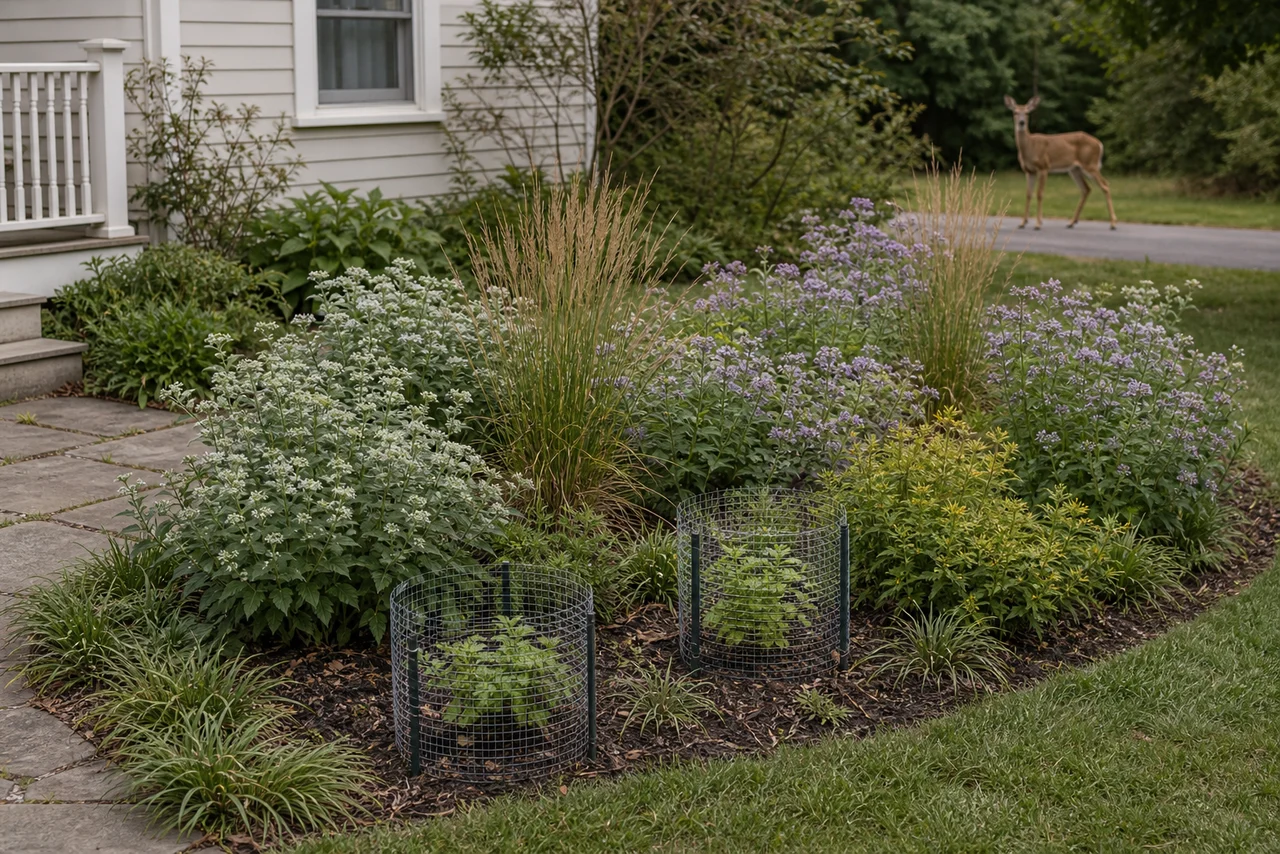
Treat deer resistance as probability, not armor
University of Maryland Extension is explicit that there is no deer-proof plant. Preferences shift with deer density, season, local food supply, weather, and an individual animal's learned route. A species that survives untouched for two years may be sampled during a hard winter; a young nursery plant may also be more attractive than the same species after its foliage toughens. The useful question is not whether deer can eat a plant, but whether that plant is less likely to suffer repeated, disfiguring browse at this site.
Confirm the culprit before redesigning the bed. Rutgers NJAES describes deer feeding damage as torn or jagged vegetation and ragged breaks on woody material. Insects, rabbits, voles, slugs, disease, drought, and a mower can produce different clues and need different responses. Photograph fresh damage beside a ruler, record the date and plant, and look for tracks or pellets without handling wildlife waste. A two-week record is more useful than buying from a generic 'deer proof' label after one missing stem.
- Occasional sampling: keep records and replace only plants that are repeatedly targeted.
- Repeated browse: combine a lower-risk palette with protection during establishment and vulnerable seasonal growth.
- Severe pressure: treat physical exclusion as the primary control instead of expecting plant choice to carry the whole job.
Build the bed around a lower-risk matrix
Start with one site-matched matrix rather than a long list. In a dry sunny bed, repeat little bluestem and clustered mountain mint, then add a restrained drift of wild bergamot. In dry part shade, repeat Pennsylvania sedge with eastern red columbine. In a separate medium-moist shade pocket, golden ragwort can make a denser ground layer. These are not interchangeable: mountain mint can spread beyond a narrow bed, while golden ragwort does not belong in a hot dry curb strip.
The palette draws from UMD's list of native species that usually do not suffer significant browse, but county-level nativity and site fit still need confirmation. The U.S. Fish and Wildlife Service Chesapeake Bay guide is a useful regional screen; state floras, local Extension guidance, and nursery provenance refine the choice. Do not import a plant merely because another state calls it native, and do not expect aroma or texture to override saturated roots, deep shade, or reflected heat.
Plant in repeated groups large enough to read after one stem is lost. A deer can erase an isolated accent in one bite; a matrix has more capacity to absorb limited sampling and regrow. Keep a visible edge and a narrow access route so damaged stems can be inspected and cut without stepping through new crowns. The layout should remain legible while temporary guards are present and after they come off.
Protect establishment before a feeding route forms
Fresh nursery growth and newly placed plugs deserve protection before deer learn that the bed is a regular stop. UMD Extension recommends installing an exclusion system before planting when practical. For a small planting pocket, a well-anchored wire-mesh guard can protect a tight group while roots establish, but it is not a miniature deer-proof fence. Keep the protected diameter compact, use stable stakes, close ground-level gaps, cap or turn sharp ends away from people and wildlife, and leave enough clearance that shoots do not project through the mesh.
Pressure determines scale. UMD's deer-management guidance reports that an eight-foot enclosure is the reliable standard for excluding deer from an area; lower barriers may discourage deer in some small configurations but should not be represented as guaranteed. A complete enclosure also needs a gate that actually closes and a perimeter checked after storms, fallen branches, mowing, and snow. If the site cannot safely or legally support that structure, design for reduced damage rather than promising exclusion.
Remove temporary guards only after the plants are rooted, the most vulnerable growth has toughened, and monitoring shows that the group is not being targeted. Reinstall protection before a known seasonal browse period if needed. Do not use loose netting that can entangle wildlife or drape nearly invisible material across a walkway. Any electric fence needs specialized installation, warning, maintenance, and local compliance beyond the scope of this small-garden plan.
Make recovery part of the design
Browse will sometimes happen even in a careful planting. After fresh damage, check whether a stem was torn, a crown was uprooted, or only the soft tip was removed. Use clean bypass pruners to make a deliberate cut back to sound tissue when a ragged stem would split or block the path; do not shear every plant into a matching ball. Water only when the root zone needs it, and avoid fertilizer used as a panic response. Excess soft growth can create more vulnerable tissue without solving the browsing pattern.
Move or protect a repeatedly targeted species instead of replacing it indefinitely. If one individual survives while its neighbors disappear, check whether the difference is access, shelter, light, moisture, or simply chance before declaring a universal winner. Keep the matrix intact by repeating the same role with another locally native, site-compatible lower-risk species. The goal is a functioning plant community, not a test of whether one favorite can be forced through chronic pressure.
Review the strategy across four seasons
Walk the bed at spring emergence, after summer drought, during autumn movement, and after winter snow or browse. Note which stems remain, where deer enter, whether guards lean, and whether foliage is pressing through mesh. A fixed photo point makes slow changes visible. It also prevents a single dramatic morning from outweighing a season of evidence.
Update the plan only when the record supports it. Add protection before the next repeat of a clear seasonal pattern, expand a successful matrix into a failed pocket, and retire barriers that no longer serve a purpose. If deer pressure becomes landscape-wide, contact the state wildlife agency or local Extension office about lawful, community-scale management. Plant selection can reduce garden damage, but it cannot correct an ecologically unsustainable deer population on its own.
The working plant palette
These roles are a starting framework. Confirm county-level nativity, provenance, mature width, and nursery availability before purchase.
University of Maryland Extension lists clustered mountain mint among natives that usually avoid significant browsing; give its spreading colony a clear path or edging boundary.
A clumping warm-season grass on UMD's lower-browse-risk list; repeat it as a visible frame in full sun and dry-to-medium soil.
Its aromatic foliage and regional habitat value make it a useful repeated summer layer; edit its spread at the bed edge rather than planting isolated singles.
A low grasslike layer for dry-to-medium shade, also included on UMD's deer-resistant native list; use enough plugs to read as groundcover.
A compact spring flower for part shade or gentler sun that UMD identifies as usually avoiding significant deer damage, though fresh growth can still be sampled.
A spreading, semi-evergreen option for a separate medium-moist shade pocket; UMD and Penn State both identify it as relatively resistant to deer browsing.
A practical sequence
Record fresh damage, tracks, season, and the exact plants affected before changing the design.
Match a lower-browse-risk native palette to measured light, drainage, mature width, and local range.
Install safe, well-anchored guards or an appropriate enclosure before vulnerable plants become a feeding stop.
Make selective clean cuts, support root establishment, and replace a repeatedly lost role rather than the whole bed.
Compare fixed-point photos across seasons and change the strategy only when a repeatable pattern appears.
- No native plant is deer-proof; resistance ratings describe relative risk and can change with season, deer density, and local food supply.
- Wire guards must be stable, visible, free of sharp ends, and checked for gaps or entanglement hazards. They should never narrow an accessible route or emergency exit.
- Tall, permanent, or electric fencing can be regulated and requires appropriate design and maintenance; check local rules and utilities first.
- Use repellents only according to the product label and local guidance. This plan does not recommend a chemical product or promise that repellents will replace exclusion.
- Confirm county-level nativity and mature size before purchase; a lower-browse-risk plant is not automatically suitable for every Mid-Atlantic site.
Continue planning
- Filter the palette by the site's real conditions: Use the Plant Finder for light and moisture, then apply the lower-browse-risk screen from the sources above.
- Adapt a compact Garden Plan: Keep the plan's repeated structure, but substitute only locally native plants that fit the site's browse pressure and mature space.
- Keep guards and plant groups visually intentional: A clear edge, repeated matrix, and open maintenance route help a protected young bed read as a planned garden.
- Establish replacement plugs carefully: Use the fall-plug guide for planting depth, watering, markers, and freeze-thaw checks after the browse strategy is ready.
- Measure light before choosing a deer-resistant list: Resistance does not compensate for a shade plant placed in reflected full sun or a sun plant placed under a summer canopy.
- University of Maryland Extension — Deer Resistant Native Plants ↗
- University of Maryland Extension — The 4 Pillars of Managing Deer Damage ↗
- Rutgers NJAES — An Overview of White-Tailed Deer Status and Management in New Jersey ↗
- Penn State Extension — Management Practices for Enhancing Wildlife Habitat ↗
- U.S. Fish & Wildlife Service — Native Plants for Wildlife Habitat and Conservation Landscaping in the Chesapeake Bay Watershed ↗
Plant ranges and recommendations change as records improve. Read how we separate range, site fit, and design judgment in our sources and methodology.