Decide whether division will solve the problem
Illinois Extension describes Monarda spreading through rhizomes, underground stems that can carry a patch into less vigorous neighbors. Division is useful when that expansion closes a path or when an older clump has vigorous growth around a thinning center. Photograph the patch at full size and mark its intended boundary before foliage disappears.
A white coating on leaves is a different clue. NC State Extension notes that wild bergamot can develop powdery mildew, especially with crowding, poor airflow, or water stress. Dividing can improve room around plants, but it will not correct deep shade, repeated drought, or a soggy planting site. A sudden collapse or soft, decaying crown deserves a diagnosis before any pieces are replanted or shared.
Choose a specific result: reopen the walk, retain one summer-flowering group, or provide two divisions for another suitable bed. If the patch is healthy and already fits, there is no benefit in creating extra root disturbance simply because a calendar says it is time.
Use emerging spring shoots as the timing signal
Iowa State Extension's guidance for Monarda recommends division in early spring when new growth becomes visible. It suggests reviewing vigorous bee balm clumps every two to three years. For a Mid-Atlantic home garden, use the appearance of shoots and workable soil rather than importing an Iowa calendar date: a sheltered coastal bed and an upland Pennsylvania garden warm at different times.
Can you divide it in fall? University of Maryland Extension permits fall division for spring and summer bloomers after flowering, while its late-season bloomers are generally divided in spring. Penn State's Chester County guidance favors spring for most divisions so plants have a full season to establish. These broader rules make fall a conditional option, not the default for this Monarda guide. A bergamot still flowering in September should remain in place.
If fall division is necessary, confirm local timing with Extension, wait until bloom has finished, and allow substantial rooting time before frozen ground. University of Minnesota Extension uses four to six weeks before the ground freezes as a general fall-division allowance. That refers to soil freezing, not the first light frost, and it is not a survival guarantee. If the remaining window is uncertain, map the move now and dig in spring.
Prepare space for the plants you will keep
NC State lists typical wild bergamot dimensions of two to four feet tall and two to three feet wide. Use that width as a planning check, then account for the spread you have actually observed. A tiny division placed six inches from a walk will not remain tiny. Set the intended mature edge back from the route, and keep room around neighboring crowns.
Here is a small-bed example: if one two-foot patch has expanded into both its neighbors, splitting it into four pieces and returning all four to the same hole preserves the crowding. Keep one substantial section in the original group and assign the others elsewhere. UMD explicitly advises against returning every division to the parent's original space.
Prepare the receiving hole before lifting roots. Match the new position to the plant's sun and drainage requirements, remove competing weeds, and have water ready. If there is no suitable destination for another group, arrange a labeled handoff or compost healthy surplus. You do not need to fill every temporary opening in a small garden.
Lift the clump and retain connected roots and shoots
Choose a cool, overcast work period. Minnesota Extension advises watering dry soil the day before dividing and keeping lifted sections shaded and moist. Set out a spade or digging fork, a clean sharp knife for resistant connections, and a tray so the pieces stay together while you work.
Work around the outside of the chosen clump, loosen beneath it, and lift with the root mass supported. Avoid pulling the plant out by its stems. In a tight border, check where neighboring plants begin before each insertion; if roots are inseparable without tearing through another established plant, stop and reconsider the size or location of the move.
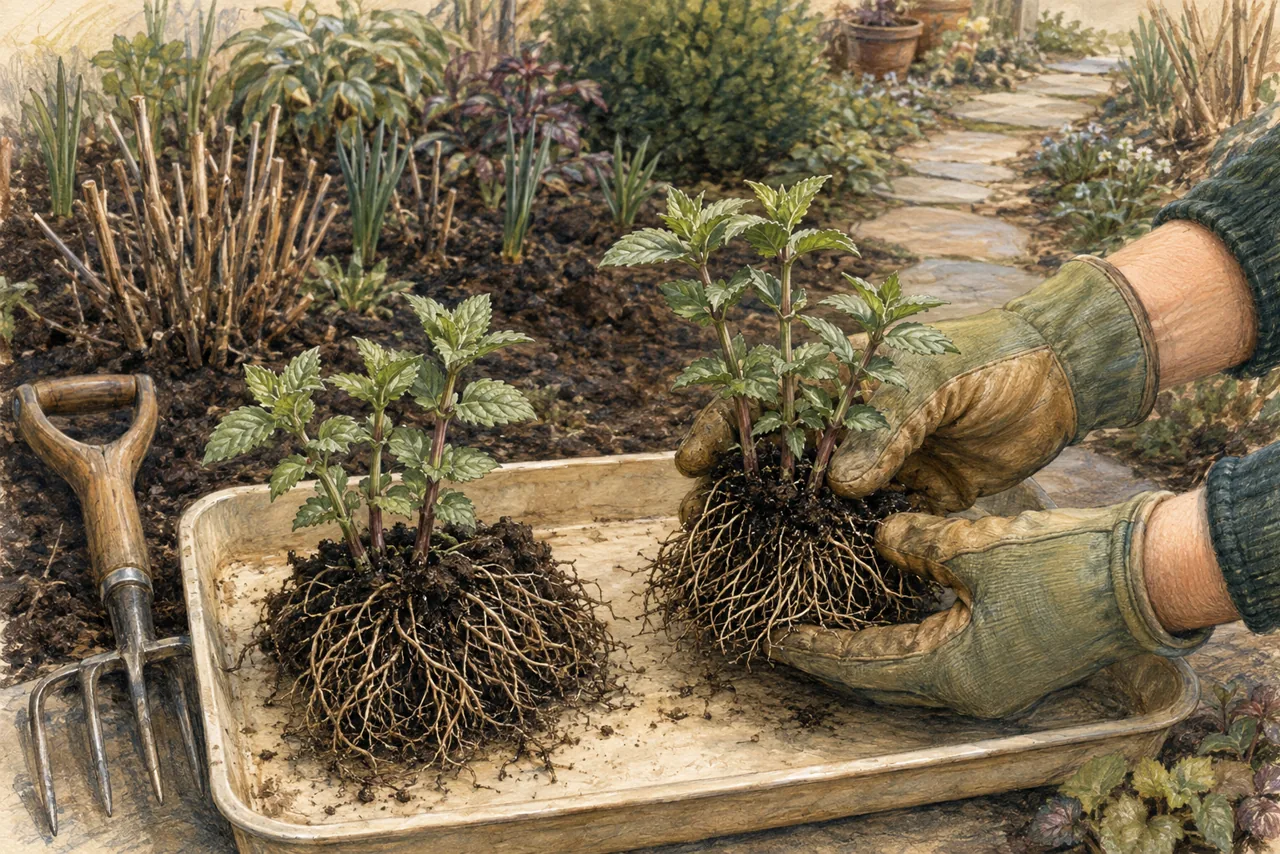
Shake off enough loose soil to see the connections. Following Penn State's division method, tease apart sections where they separate naturally and cut resistant connections cleanly. Select vigorous outer growth; exclude a dead center. Each retained section needs living shoots attached to a healthy root system. Three to five shoots per piece is the general UMD guideline, and substantial pieces are easier to establish than many tiny fragments.
Keep roots out of drying wind and direct sun, and replant as soon as the sections are ready. Clean soil from tools between clumps. If unexpected decay, pests, or a weed rhizome is tangled through the roots, isolate that material instead of passing the whole mass into another bed.
Replant promptly and check the root zone
Return the crown, where shoots meet roots, to its previous soil level after settling. Spread the roots in a hole that accommodates them, backfill gently, and water to settle soil around them. Penn State advises firming the soil and watering without washing it away from the roots. Keep mulch clear of the emerging shoots.
Check moisture beside the roots during establishment and after drying weather. Water when the root zone needs it; rainfall totals alone do not reveal whether a newly replanted section has dried out. Its reduced roots need attention even if the mature parent tolerated dry spells. Avoid leaving the planting constantly saturated.
A little temporary wilting can follow handling. Persistent wilt calls for a closer look at soil moisture, crown depth, and drainage before adding more water. Let new growth establish before judging the final outline of the patch. Record the division date and the number of sections retained so next year's maintenance responds to what the plant actually did.
Keep the surrounding habitat and a manageable edge
NC State identifies old hollow wild bergamot stems as nesting sites for native bees. Work on the smallest part of the patch that resolves crowding and retain undisturbed stems elsewhere when possible. A division job does not require clearing every standing stem or collecting every seedhead in the bed.
Mark the new clump and photograph the clear path beside it. Check that boundary again after the summer canopy develops. If bergamot repeatedly overwhelms the same small space, a larger designated patch or a different site-matched plant may be more practical than increasingly frequent division.
Apply separate guidance to nearby natives. Iowa State's perennial guide recommends spring division for asters, but identifies butterfly weed and blue wild indigo as difficult to divide because of their roots. Success with a spreading Monarda is not a reason to slice through every perennial in the border.
Check the parent plant before dividing
Use the original planting record or a reliable identification. Record any cultivar name when labeling divisions for another gardener.
A rhizome-spreading native perennial for a sunny, well-drained site. Keep the new group within a measured footprint and monitor its edge as growth resumes.
A practical sequence
Record the crowding, mark the desired mature edge, and choose where retained divisions will go.
Wait for emerging shoots and workable soil; water beforehand if the soil is dry.
Prepare receiving holes, lift the clump, and separate a few vigorous sections with roots and shoots connected.
Replant, settle the soil with water, label each group, and keep mulch away from shoots.
Check root-zone moisture and the path boundary; review the mature footprint later in summer.
- Avoid routine division while the plant is flowering, during hot dry weather, or in saturated or frozen soil.
- Keep roots attached to living shoots; a clipped stem or an unrooted fragment is not a ready-to-replant division.
- Do not distribute divisions with unexplained decline, decaying crowns, pests, or invasive weeds mixed through the roots.
- Preserve neighboring plants and undisturbed habitat where possible; this method concerns established garden plants, not wild collection.
Continue planning
- Check wild bergamot's growing conditions: Review the parent species before choosing a destination for a division.
- Find plants that fit the space left beside it: Compare light, moisture, and mature height before adding another neighbor.
- Review the Garden Plans: Use repeated groups and defined access to decide how many plants the bed can accommodate.
- Give the renewed patch a clear edge: Keep a visible boundary and a useful walking line as the divisions grow.
- Compare division with collecting seed: Seed follows a different propagation process and can produce more variation than a division of the parent plant.
- Check timing for new nursery plugs: Use the installation guide when starting with purchased plants rather than lifted divisions.
- Iowa State Extension — When Is the Best Time to Divide Bee Balm? ↗
- University of Maryland Extension — Perennials: Selection, Planting, and Care ↗
- Penn State Extension, Chester County — Dividing Perennials ↗
- University of Minnesota Extension — How and When to Divide Perennials ↗
- NC State Extension Plant Toolbox — Monarda fistulosa ↗
- Illinois Extension — Bee Balm for the Home Landscape ↗
- Iowa State Extension — How to Divide and Transplant Perennials ↗
Plant ranges and recommendations change as records improve. Read how we separate range, site fit, and design judgment in our sources and methodology.