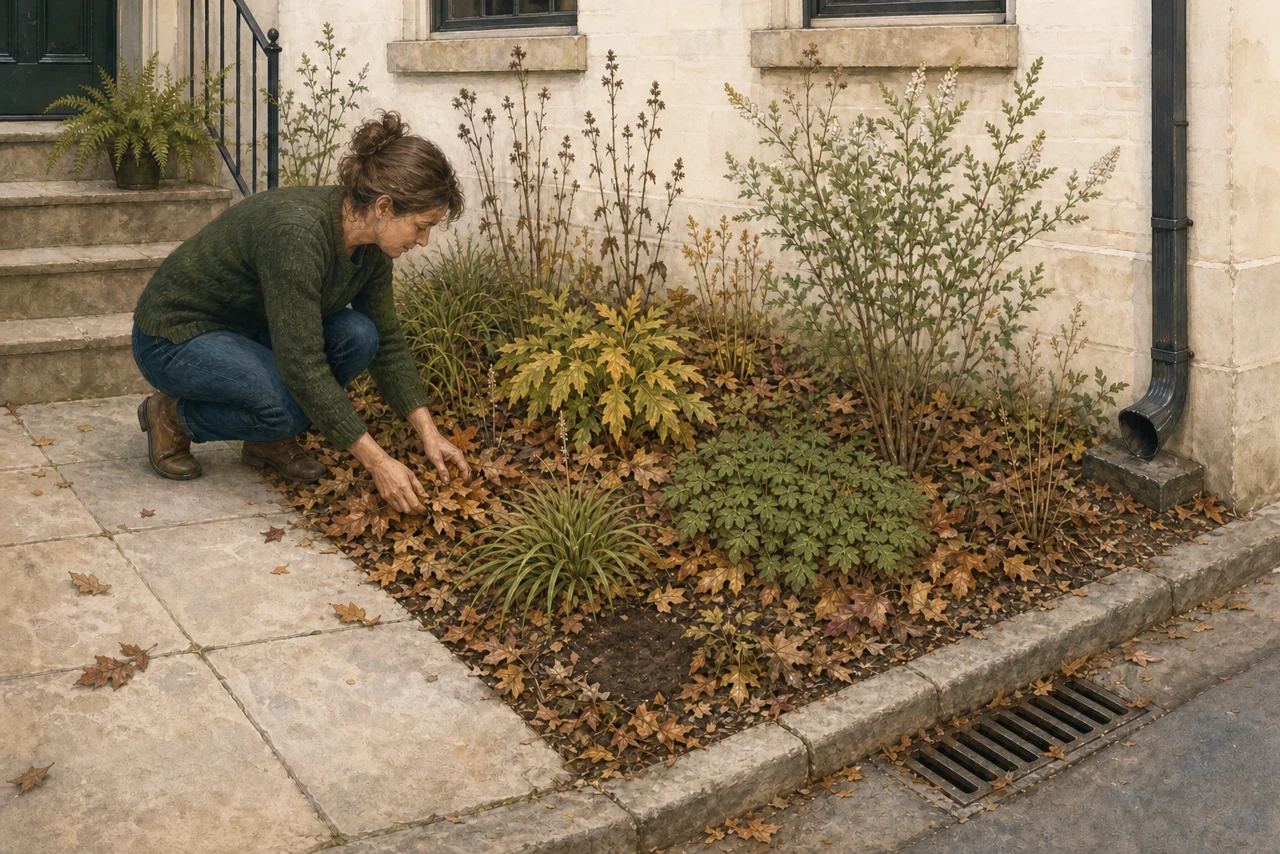
Treat leaf care as routing, not total cleanup
A small Mid-Atlantic yard rarely has room to leave every leaf exactly where wind drops it. The useful goal is not zero movement; it is keeping healthy leaf litter on the property in places where it can function without blocking access or water flow. Rutgers NJAES recommends moving leaves from lawns and walkways into garden, tree, or forest beds, while University of Maryland Extension describes small untouched patches and ‘tree shadows’ beneath canopies as useful overwintering habitat.
Draw three zones before the main leaf fall. The receiving zone is a healthy planted bed beneath trees or shrubs. The clear zone includes walks, steps, active turf, vents, drains, gutters, curb openings, and maintenance access. The overflow zone is a contained leaf-mold or compost area, or the municipality's approved collection route. This map prevents the last windy afternoon of the season from becoming an all-or-nothing decision.
- Receive: healthy native beds, tree-shadow plantings, and sheltered shrub borders.
- Keep clear: walking and service routes, lawn still being kept as turf, and every stormwater opening.
- Hold overflow: a contained compost or leaf-mold area that does not spill into a drain, street, neighboring property, or building access.
Move whole leaves with the least disturbance
Use a hand rake or a reusable tarp to move leaves in short batches. Whole leaves retain more habitat value than shredded material, so do not run every leaf through a mower or shredder merely to make it fit. Rutgers notes that shredding reduces habitat value for beneficial insects; UMD likewise recommends intact litter for overwintering wildlife.
Place leaves loosely between established plants instead of pressing them into a uniform blanket. Standing perennial stems and a few small twigs can slow wind and hold the material inside a defined edge. Do not bury low evergreen foliage, pack leaves around a trunk or woody stem, or fill the bed to a target depth borrowed from another site. Leaf size, moisture, plant size, and exposure determine whether the layer stays airy or collapses into a mat.
If a dense drift forms against a fence or in one corner, lift and redistribute it while the leaves are dry enough to move. The destination should still show plants, edges, and access. A crisp boundary and a clear walk communicate that the habitat layer is maintained, even when the leaf surface is irregular.
Keep water routes and daily access visible
Wet leaves can make a path or step slippery, and leaf debris should never be sent into a storm drain. Rutgers explains that many home properties connect directly to waterways through storm-drain systems and instructs residents not to discharge leaf debris there. Clear grates, curb openings, downspout outlets, rain-garden inlets and overflows after each major drop and again after heavy rain.
A rain garden is not automatically a leaf-storage basin. Keep its inflow and overflow working, then place retained leaves in an adjacent planted shoulder or another receiving bed that will not obstruct designed water movement. If a downspout already causes erosion or sends water toward a foundation, solve that drainage problem separately instead of using leaves as a plug.
Maintain the width of the route actually used by people, pets, bins, hoses, and emergency access. Sweep or rake leaves from hard surfaces into the receiving bed rather than blowing them toward the street. Recheck the clear zone at night or in rain, when a low curb edge or final step is harder to see.
Know the exceptions before material enters the habitat bed
Healthy leaves and stems can support insects through winter, but UMD advises removing leaves and standing material affected by disease when sanitation is needed to limit reinfection. Keep diseased material out of a casual home compost pile unless local guidance confirms that the process will control the pathogen. Collect fallen fruit separately when it is supporting a known pest cycle.
Pull invasive plants and seed-bearing material before they disappear beneath the leaf layer. Do not sweep road grit, deicing salt, pet waste, plastic, or unknown curb debris into a native bed. The receiving zone is habitat, not a place to hide every material that happens to be on the pavement.
Ticks are also a site-management consideration in the Mid-Atlantic. Keep leaf litter away from the route where people and pets brush through vegetation, and follow local public-health guidance for the property. Concentrating habitat in a planted zone lets the rest of a very small yard remain legible and usable.
Inspect in spring instead of removing everything by date
There is no single spring date when every leaf must leave the garden. U.S. Fish and Wildlife Service notes that insects use leaf litter, stems, soil, logs, and other structures in different life stages. Turning or bagging the entire layer on the first warm day can undo the winter refuge just as activity begins.
Leave the layer in place where shoots can emerge and water still moves. UMD says soil organisms gradually break intact leaves into a thinner layer; it also recommends gently moving extra-deep piles that threaten to smother sensitive plants. Use that plant-by-plant signal rather than stripping every square foot. Lift a wet mat from a small crown, reopen a path edge, and move the material a short distance within the bed.
Photograph the same receiving zone after leaf fall and again as spring growth begins. If leaves repeatedly blow out, add more living groundcover or keep selected stems instead of buying a deeper decorative mulch layer. If crowns repeatedly disappear under one corner, reduce the amount routed there and expand the compost or second receiving zone next fall.
The working plant palette
These roles are a starting framework. Confirm county-level nativity, provenance, mature width, and nursery availability before purchase.
Rutgers documents golden ragwort growing among leaf litter, and its spreading foliage can help a medium-moist shade bed read as intentional. Pull aside an unusually deep wet mat if it begins to cover the living rosettes.
University of Maryland Extension lists it for drought-tolerant part shade. Use repeated plants beneath a compatible canopy so the receiving area remains a planted ground layer rather than an unbounded leaf pile.
A small spring-flowering accent for dry-to-medium part shade. Mark young plants before leaf fall so a heavy drift can be loosened without raking out the crowns or seedlings.
Where moisture and mature width fit, one shrub gives leaves a sheltered destination beneath woody cover. Keep the stem base visible and preserve access rather than packing leaves against the plant.
White wood aster
Eurybia divaricata
A locally appropriate woodland-edge aster can share a leaf-receiving bed and keep standing stems through winter. Confirm county-level range and allow for its self-seeding habit before adding it to a very small space.
A practical sequence
Map receiving, clear, and overflow zones; mark small plants and confirm local collection rules.
Move healthy whole leaves from walks and active lawn into the planted receiving bed in loose batches.
Reopen drains, inlets, steps, and paths; redistribute only the deep wet drifts that cover small plants.
Leave stable patches and standing stems undisturbed while continuing safety and drainage checks.
Let shoots emerge through the layer; gently shift mats only where plants or water movement show a problem.
- Never leave wet leaves on stairs, ramps, sidewalks, curb access, or another surface where they create a slip or visibility hazard.
- Keep all storm drains, gutters, downspout outlets, rain-garden inlets and overflows, vents, utility access, and building exits clear.
- Remove diseased plant material, known pest-infested fruit, invasive seeds, salt-contaminated debris, and trash instead of routing them into habitat beds.
- Do not use a fixed leaf depth as a universal rule. Gently redistribute an extra-deep or wet mat when it covers sensitive plants or blocks air and water movement.
- Keep high-contact routes for people and pets separate from retained leaf litter, and follow local tick, fire-safety, sanitation, and property-maintenance guidance.
- Confirm county-level native range and each plant's light, moisture, and mature-width fit before adding a new receiving bed.
Continue planning
- Filter plants for the receiving bed: Start with the bed's measured light and moisture, then confirm county-level range and mature habit.
- Adapt the Soft Landing Garden Plan: Use its woodland-edge layers beneath a small deciduous tree while preserving a clear path and trunk access.
- Review golden ragwort for a moist shade pocket: Check its spreading habit and site fit before using it as a living edge around retained leaves.
- Use Pennsylvania sedge in drier shade: Build a repeated, low ground layer where the soil is dry-to-medium and well drained.
- Keep the habitat layer visually intentional: Combine a crisp boundary, repeated plants, and a maintained access route instead of stripping the bed bare.
- Turn an unused shady lawn edge into a receiving bed: Reserve foot traffic first, then establish a site-matched sedge matrix beneath the canopy.
- Rutgers NJAES — Why Leave the Leaves and How to Do It ↗
- University of Maryland Extension — Managing City and Suburban Yards and Gardens to Sustain Insect Communities ↗
- University of Maryland Extension — Groundcovers ↗
- U.S. Fish & Wildlife Service — Winterize Your Pollinator Garden ↗
- Rutgers Organic Land Care — Protecting Water Resources ↗
- University of Maryland Extension — Leave the Leaves for Natural Pest Control ↗
Plant ranges and recommendations change as records improve. Read how we separate range, site fit, and design judgment in our sources and methodology.