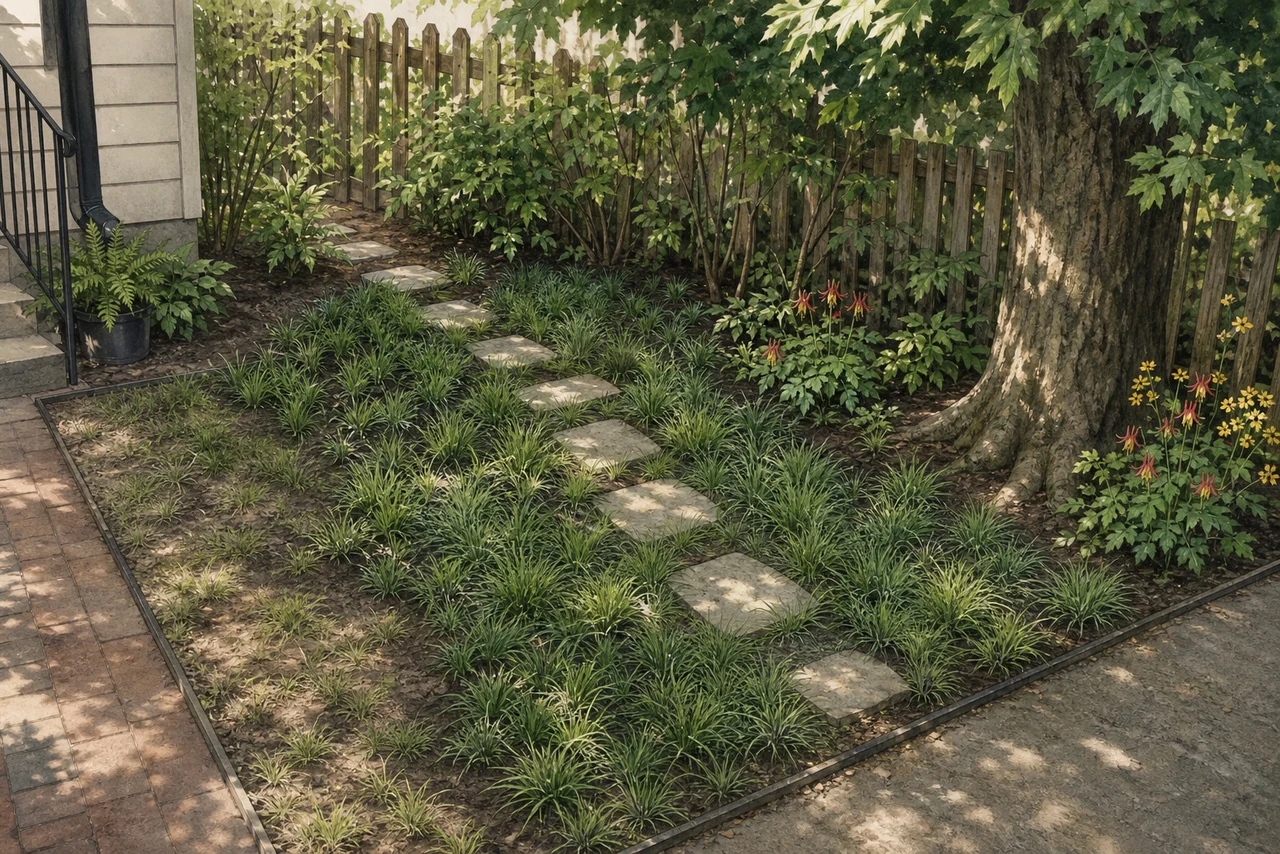
Decide whether the square should still function as lawn
Begin with use, not species. University of Maryland Extension notes that conventional lawn remains valuable for play, pet runs, sports, and other high-wear routes. Groundcovers do not all tolerate trampling or the compaction that follows it. If the 10 × 10-foot patch is the only route to a gate or is where a dog turns at speed, a sedge carpet will not solve the real problem. Keep that route as turf or build a stable, code-appropriate path, then convert the unused margins.
A good candidate is a thin, lightly used lawn that repeatedly loses vigor beneath a leafy canopy or building shadow. Measure light after leaf-out, then feel the soil a few inches down after rain and again during a dry week. Pennsylvania sedge is a credible choice for dry-to-medium, well-drained part shade; standing water, reflected full sun, or deep compacted traffic calls for a different plant community or a different surface.
- Convert: an ornamental or pass-through area where footsteps can stay on a path.
- Keep some turf: a durable play, pet, or gathering surface that is still growing acceptably.
- Reassess first: an eroding slope, persistent puddle, failing retaining edge, buried utility conflict, or hazardous root heave.
Treat sedge as a matrix, not a magic species
Both UMD and Penn State Extension identify native sedges as options for shady lawn alternatives, but Carex is a large genus with species adapted to different soils. Mt. Cuba Center's four-year Mid-Atlantic evaluation reinforces that distinction: Pennsylvania sedge made a fine-textured loose carpet in sun and shade, while Wood's sedge formed a denser mat and suppressed weeds more effectively in the trial's average soil. A trial result in Delaware is useful regional evidence, not a guarantee for every compacted backyard.
Use one site-matched sedge for most of the ground layer so its growth can read as a continuous surface. Add flowering plants only along the non-walked edge or in two or three repeated pockets. Eastern red columbine can lift spring color through a dry-to-medium part-shade edge; golden ragwort belongs in a distinct cooler, medium-moist pocket. The accents are habitat and seasonal structure, not substitutes for stepping stones.
Confirm that the straight species is native in the reader's county or physiographic region, not merely somewhere in the eastern United States. Check state flora records, USDA PLANTS, local Extension guidance, and nursery provenance. A named cultivar may behave differently from the straight species and should not inherit a trial claim that was made for another selection.
Turn 10 × 10 feet into an honest plant order
Draw the square to scale and reserve access before counting plants. A straight 2-foot-wide path crossing a 10 × 10-foot square occupies about 20 square feet, leaving roughly 80 square feet for vegetation. Curves, existing roots, and edge accents reduce that number further. Do not order from the full 100 square feet and then squeeze the extras around a trunk or over a walkway.
Use the grower's recommended on-center spacing for the exact plant and size you are buying. For a rough square-grid estimate, divide plantable area by the spacing in feet squared. Eighty plantable square feet works out to about 80 plugs at 12-inch centers, 51 at 15-inch centers, or 36 at 18-inch centers. Those numbers are ordering estimates, not universal spacing rules: closer planting costs more and covers sooner, while wider planting leaves more time and open ground for weeds. UMD advises flexibility because excessive crowding can also increase competition and disease risk.
If that cost or labor feels uncertain, follow UMD's small-start approach. Mark a 4 × 4-foot pilot in the same light and moisture, keep a fixed photo point, and watch one full growing season before expanding. The pilot reveals winter appearance, summer dryness, weed pressure, browsing, and whether the chosen path actually carries the traffic.
Remove turf with the roots beneath it in mind
For an open small patch without woody roots, UMD describes slicing beneath the top 1–2 inches of sod or smothering turf with a light-blocking cover and removing that cover before planting. A 100-square-foot conversion sits at the upper limit of its hand-removal example. Choose a method that fits the turf species, planting date, slope, and labor available; do not rototill merely because the square is small, since tilling can surface weed seed and damage soil structure and roots.
Under an established tree, switch methods. Penn State recommends removing grass and weeds with a hand trowel, avoiding spades that nick roots, leaving the root flare visible, and moving a planting hole when a large woody root is encountered. Do not create a raised bed over the root zone or pile compost and soil against the trunk. Use plugs or young plants because their small holes can fit between roots with less disturbance.
Clear perennial weeds before the sedges go in. If cardboard, fabric, or another temporary smothering cover was used, remove it before planting rather than cutting permanent holes through it. Set every plug at the same depth it grew in its cell, firm the surrounding soil, and keep mulch thin enough that spreading shoots can reach open soil. A clean visible edge helps separate the new matrix from surviving turf without turning the garden into a plastic-lined tray.
Establish the ground layer before calling it low-maintenance
Water each plug thoroughly at planting, then check the root zone rather than following a calendar. UMD recommends feeling the soil a few inches deep and watering groundcovers when it becomes mostly dry, especially where tree roots compete. Rain caught by a gauge does not prove that water reached soil beneath a dense canopy. The goal is evenly supported root establishment, not permanently wet crowns.
Weed while invaders are small and before they seed. Temporary leaf litter or a light organic mulch can protect open soil, but pull mulch away from crowns and gradually let the living matrix occupy the gaps. Expect regular observation and hand weeding during establishment. ‘No-mow’ does not mean no work; it means weekly turf mowing is exchanged for a different, usually lighter set of tasks once coverage is dense.
Mt. Cuba's mowing evaluation shows that several sedges, including Pennsylvania sedge, can recover from mowing. It does not prove that they will tolerate cleats, repeated dog traffic, or the same mowing schedule as turfgrass. Leave the planting unmown unless the selected species and design call for an occasional cut, and use the species-specific late-winter guidance rather than scalping a young matrix to imitate a lawn.
Review function and coverage after one full cycle
Photograph the same view after planting, at midsummer, after leaf fall, and the following spring. Mark gaps as traffic, dry pockets, standing-water pockets, weed competition, animal disturbance, or plant loss rather than treating every opening alike. Extend stepping stones where footprints keep appearing; do not keep replanting a shortcut with more sedge.
Where the matrix is healthy, divide or add the same sedge to close selected gaps. Where it thins repeatedly, revisit moisture, soil compaction, and species choice before buying replacements. Keep fallen leaves beneath a tree unless an unusually deep mat is smothering small plants, and keep the trunk flare clear. A successful conversion should become more continuous and easier to edit, while remaining a planted groundcover with limits—not a maintenance-free synthetic carpet.
The working plant palette
These roles are a starting framework. Confirm county-level nativity, provenance, mature width, and nursery availability before purchase.
Use as the repeating low ground layer in dry-to-medium, well-drained part shade. Mt. Cuba's Mid-Atlantic trial found it formed a loose, spreading carpet and tolerated mowing, but its lawn use is still limited to light foot traffic.
Wood's sedge
Carex woodii
Mt. Cuba's trial rated this spreading sedge highly in shade and found it denser and more weed-suppressing than Pennsylvania sedge. Confirm local range and match it to average rather than chronically dry or wet soil before purchase.
Place small repeated groups outside the walking line in a dry-to-medium part-shade pocket; its upright spring flowers rise above the sedge without becoming the traffic surface.
Use only in a separate medium-moist shade pocket where a spreading flowering ground layer is useful. Do not mix it indiscriminately through a dry Pennsylvania sedge matrix.
A practical sequence
After leaf-out, map direct light, moisture, roots, weeds, and the route people or pets actually use.
Test a 4 × 4-foot patch when species fit, labor, or winter appearance is uncertain.
Reserve a durable path, calculate only the remaining plantable area, and confirm local range and grower spacing.
Remove or smother turf with a method that protects soil and tree roots, then plant small plugs at crown level.
Check moisture, weed early, photograph fixed points, and expand only after the matrix performs through a full cycle.
- Native sedges are groundcovers, not universal replacements for high-traffic turf. Keep or build a durable route for frequent foot, pet, or equipment movement.
- Pennsylvania sedge is a dry-to-medium, well-drained choice; do not use this plan for a soggy depression simply because the site is shady.
- Under mature trees, preserve the trunk flare and woody roots. Do not till, pile a raised bed over the root zone, or cut large roots to make a plant grid fit.
- Plug counts are estimates derived from plantable area and the supplier's spacing; actual growth rate varies with plant size, site, provenance, and first-year care.
- Check local rules, utilities, and county-level native range before conversion, especially along sidewalks, shared property lines, drainage routes, and rights-of-way.
Continue planning
- Filter plants by the square's measured conditions: Use the Plant Finder for light and moisture before confirming local range and the sedge's exact habit.
- Adapt the Soft Landing Garden Plan: Reuse its sedge, columbine, and repeated-group logic around a small tree while preserving a practical access route.
- Plan for dry shade beneath established roots: Read the regional dry-shade guide when canopy competition, not just building shade, controls the site.
- Measure shade after trees leaf out: A day of observations separates direct sun, dappled light, and bright shade before plants are ordered.
- Choose a realistic plug-planting window: Use soil condition, available water, and establishment time rather than a single region-wide calendar date.
- University of Maryland Extension — Lawn Alternatives ↗
- University of Maryland Extension — Groundcovers ↗
- University of Maryland Extension — Lawn (Turfgrass) Removal Methods ↗
- University of Maryland Extension — Starting a New Lawn ↗
- Penn State Extension — Turfgrass Alternatives ↗
- Penn State Extension — Underplanting Trees: Respect the Roots ↗
- Mt. Cuba Center — Carex as Problem-Solving Perennials ↗
- Mt. Cuba Center Trial Garden — Carex pensylvanica ↗
- USDA NRCS — PLANTS Database ↗
Plant ranges and recommendations change as records improve. Read how we separate range, site fit, and design judgment in our sources and methodology.